GUN RUNNERS: RICO
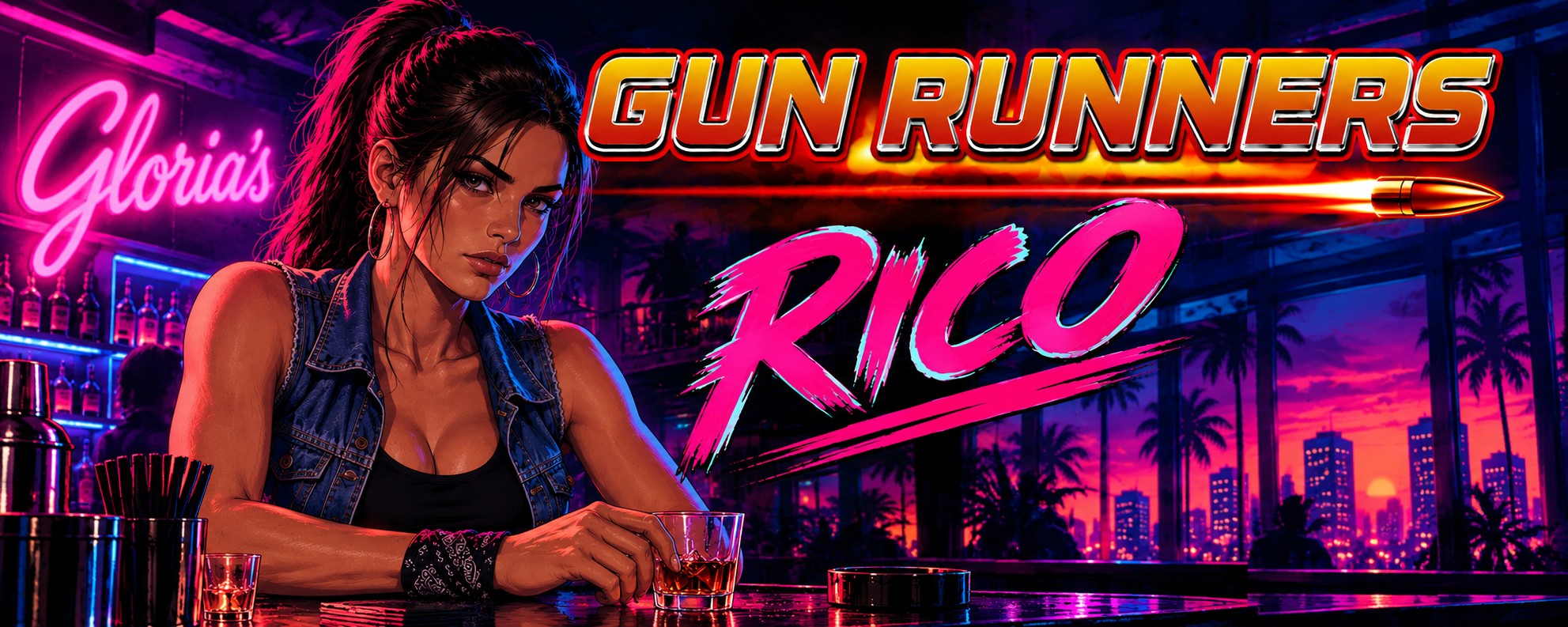
Everybody in Gun Runners has a story before the story. This one belongs to a college kid working nights behind the bar at a place called Gloria’s, six days into the job, five days into paramedic school, and about to earn a name that sticks for the rest of the saga.
This free short story is part of the mainline: one night at Gloria’s, Miami, 1983. Read it below, free, no strings attached.
By nine-thirteen on Friday night, Danielle had been working at Gloria’s for exactly six days, attending Miami Dade College for exactly five, and questioning every decision that had led to either of those things for approximately four hours.
The evening had begun beautifully, which should have warned her.
Outside, Miami shimmered beneath a recent shower, the streets wet enough to catch every electric sign and throw it back twice as bright. Pink rolled across puddles. Blue crawled over chrome. Headlights smeared white along Biscayne like someone had dragged a paintbrush through the city before the colors had dried. Heat still clung to everything despite the rain, wrapping itself around people the second they stepped outside, but from behind the glass at Gloria’s it was almost romantic. Palm trees moved lazily against a purple-black sky. The skyline glowed beyond them. Out past the palms, tires hissed over wet asphalt.
Inside, Chloe Love was doing most of the work.
Bright synths spilled from the sound system, big drums punching through the chatter as Dancing in the Neon Rain rolled across the upstairs bar. Chloe’s voice soared through the room, smooth and huge, carrying that strange Welsh-American edge that made every line sound like it had traveled across an ocean before finding Miami.
City’s glowing, hearts collide, music burns like fire inside. Every streetlight calls my name, I’m alive inside the flame.
The song suited Gloria’s almost indecently well. The upstairs bar was the public face of the place: street-level, windows, neon, beer signs, a long polished counter scarred by years of glasses, rings, elbows and conversations nobody would admit to having the next morning. The pink script of GLORIA’S burned against one wall, reflected backwards in the mirror behind rows of bottles. Ceiling fans stirred the warm air without making any measurable difference to it. Booths hugged the windows. The staircase at the rear led down into Gloria’s real kingdom, the darker underground room where the lighting dropped, the whiskey improved and people generally knew better than to ask strangers what they did for a living.
Danielle worked upstairs. For now.
She was twenty-two, sharp-eyed, dark-haired and permanently three seconds away from deciding that whatever nonsense was happening in front of her was beneath serious discussion. Tonight her hair was pulled into a practical ponytail, keeping it clear of a face that already possessed the watchful quality of someone considerably older. A denim vest sat over a black tank top. A black bandana was tied tight around one wrist. She moved behind the bar quickly but without wasted motion, every bottle returning to exactly where it had come from, every glass landing precisely where she intended.
There were bartenders who performed. Danielle did not. She poured, she charged, she watched.
“There were bartenders who performed. Danielle did not. She poured, she charged, she watched.”
She had already discovered that bar work and emergency medicine shared several important principles: assess the situation, identify the biggest immediate problem, keep idiots from making it worse, go from there. Unfortunately, Gloria’s possessed substantially more idiots than Miami Dade’s paramedic course.
Her first week at college had introduced her to airway management, human anatomy, vital signs, medical terminology and a lecturer named Dr. Kaplan who could turn the phrase “cardiovascular perfusion” into a personal accusation. Danielle liked it. The work made sense. Bodies obeyed rules. Blood moved for a reason. Lungs did specific things. If something stopped functioning, there was a sequence you followed to work out why.
People were much less organized.
Gloria had hired her the previous Saturday after a conversation lasting perhaps four minutes.
“You worked a bar before?” Gloria had asked.
“Yes.”
“Any good?”
“Yes.”
“People piss you off?”
“Yes.”
“You gonna cry about it?”
“No.”
“You start Monday.”
Danielle was still not entirely certain whether that counted as an interview.
Gloria herself had spent the night downstairs at war with a supplier. Forty minutes ago she had stormed up the staircase with a delivery docket crushed in her fist, heading for the front door and the truck parked outside it.
“If that son of a bitch sends me light beer again, I’m driving the truck through his house.”
“Want me to call him?” Danielle had offered.
“I want you to hold the bar. Can you hold the bar?”
“Yes.”
“You gonna cry about it?”
“Still no.”
Gloria had pointed the docket at her like a loaded weapon and gone out into the night. Danielle had elected not to ask for clarification.
That left her in charge upstairs, which had been fine for approximately seven minutes.
Chloe Love reached the chorus.
I’m dancing in the neon rain, trying to wash away your name. Every tear turns into light, I’m shining through the night.
Danielle slid two beers toward a pair of construction workers, collected three dollars from a woman wearing enough gold to destabilize a small currency, popped another bottle on the opener and caught the cap before it hit the floor.
The bigger of the two construction workers, a sunburned slab of a man with plaster dust still in his eyebrows, tipped his bottle at her. “You’re the new one.”
“Six days.”
“Gloria fire you yet?”
“She’s busy.”
He grinned. “Give her time.”
“Give me a tip.”
He laughed and slid a dollar across the counter.
Then four young men approached the bar.
They arrived as a unit, which was mistake number one. They were all trying very hard to appear casual, which was mistake number two. They were wearing jackets despite Miami currently being approximately the temperature of the sun, which suggested either criminal enterprise or adolescence.
Danielle studied them.
They studied her right back.
The tallest one smiled. “Evening.”
“No.”
His smile stalled. “I didn’t ask anything yet.”
“You’re going to.”
The four exchanged glances. Danielle dried a glass.
The tall one recovered. “Four beers.”
“IDs.”
All four produced identification so quickly it was almost synchronized. Danielle took the first Florida driver’s license and checked the photograph, then the boy, then the photograph again. “This is a forty-three-year-old man named Gerald.”
The boy beamed. “That’s me.”
“You’ve had a difficult year.”
His friends snorted. Gerald stiffened. “It’s an old photograph.”
“The photograph has a mustache.”
“I shaved.”
“The photograph is six foot four.”
“I slouch.”
“You’re five foot seven.”
“I slouch a lot.”
Danielle put the license flat on the bar.
The second boy pushed his forward. She picked it up, studied the Massachusetts license, and raised an eyebrow. “Patricia?”
The boy’s ears turned pink.
Danielle turned the license around. A fifty-something woman with a perm beamed out of the plastic.
One of his friends leaned in. “Mom?”
“Shut up.”
“Is that actually your mom?”
“Shut up.”
“Your mom looks great.”
“Seriously, shut the fuck up.”
Danielle moved to the third before the evening became a family therapy session.
This one was better. Actually, considerably better. Male. Twenty-one. Brown hair. Similar build.
Danielle raised her eyes from the license to its owner. “Date of birth?”
“February twelfth, nineteen sixty-two.”
“Address?”
His Adam’s apple bobbed. “It’s on there.”
“Yes.”
“So you already know it.”
“I do.”
“Then why are you asking?”
“To see if you do.”
He turned to Gerald. Gerald turned to Patricia. Patricia turned to the fourth boy.
The fourth boy quietly began putting his license back in his wallet.
Danielle held out her hand.
He sighed and surrendered it.
She studied the photograph, then him, then the photograph again. “This man is Asian.”
“Adopted,” the boy said.
Danielle stared at him.
He was blond.
The construction worker at the end of the bar had begun following proceedings with considerable interest. He took a drink and muttered, “Strong defense.”
Danielle gave the blond boy his license back. “Out.”
Gerald leaned across the bar. “Come on.”
“No.”
“One beer.”
“No.”
“We’re eighteen.”
“That sentence has never improved an argument.”
“We can vote.”
“Go elect a beer.”
Patricia laughed so hard he had to turn away. Gerald shot him a murderous look. “Fuck you, Patricia.”
“Stop calling me Patricia.”
“Your license says Patricia.”
“It’s my mom.”
The third boy stared at him. “You stole your mom’s license?”
“I borrowed it.”
“You have your mom’s face?”
“Will everybody shut the fuck up?”
Danielle collected the four licenses into a neat stack. “You can collect these tomorrow.”
Gerald’s face fell. “Hey. You can’t keep them.”
“You can explain that to Gloria.”
“Who’s Gloria?”
Danielle pointed at the enormous pink sign.
All four boys stared at it.
There was a pause.
“Oh,” Gerald said.
“Tomorrow.”
They withdrew, not quickly enough to preserve dignity but fast enough to preserve themselves.
The construction worker toasted their retreat. “Go elect a beer. I’m stealing that.”
Danielle put the licenses beneath the register.
Problem solved.
She returned to pouring drinks.
At nine-twenty-one, the cocaine dealers arrived.
Danielle did not know they were cocaine dealers. Not immediately. She knew only that they were two men in expensive shirts entering separately and pretending not to know one another with such theatrical determination that they might as well have walked in holding a banner reading WE ABSOLUTELY KNOW EACH OTHER.
The first took a stool near the middle of the bar. White linen jacket, open collar, gold chain, dark hair pushed back. The Miami uniform for a man who wanted strangers to assume he owned a boat.
The second stood near the window. Pale blue shirt, cream trousers, sunglasses.
At night.
Indoors.
Danielle distrusted him immediately.
Anyone wearing sunglasses indoors after sunset was either famous, blind or selling something. He did not look famous.
He drifted to the bar just long enough to order. “Club soda. Lime.”
“Lime’s extra.”
“Fine.”
The man on the stool never turned his head. “Scotch. Rocks.”
Danielle served both.
Nothing happened for almost three minutes.
Then the man in sunglasses placed a matchbook on the edge of the windowsill.
The man at the bar scratched his left ear.
Danielle watched this in the mirror.
Sunglasses tapped the matchbook twice.
Gold Chain adjusted his watch.
Danielle polished a glass.
Neither man turned toward the other.
It was the least subtle secret communication system she had ever witnessed.
Sunglasses tapped twice again.
Gold Chain scratched his ear again.
The construction worker at the end of the bar noticed it too. “You boys got fleas?”
Gold Chain turned slowly. “Excuse me?”
The construction worker raised his beer. “Nothing.”
Danielle gave him a look.
He took the hint, then leaned across the bar and dropped his voice. “Ten bucks says Shades over there is a cop.”
“He’s not a cop.”
“How do you know?”
“Cops can’t afford that shirt.”
He considered the shirt with professional respect and returned to his drink.
Then the four fake-ID boys returned.
Danielle closed her eyes. Just briefly.
Gerald approached the bar. “We forgot something.”
“Your adulthood?”
“My wallet.”
“You’re holding it.”
Gerald studied the wallet in his hand as if it had betrayed him.
His friends immediately began laughing.
He glared at them. “My other wallet.”
“You own two wallets?”
“Yeah.”
“Why?”
Gerald had clearly not anticipated a follow-up question. “Money.”
“You keep different money in different wallets?”
“Yes.”
“What kind of money?”
Gerald hesitated. “Canadian.”
Danielle stared at him.
“We went to Toronto.”
“When?”
“Summer.”
“What part?”
Gerald’s brain visibly searched for Canada. “The cold part.”
Patricia folded over against the bar.
Danielle pointed toward the door. “Out.”
“But—”
“Gerald.”
He stopped dead. “You know that’s not my name.”
“I know.”
Something about the way she said it convinced him this was worse.
The boys retreated again.
Unfortunately, Patricia backed directly into Sunglasses.
The matchbook fell.
The room did not stop. The music continued. The fans continued. Nobody screamed. But Danielle watched both men react like someone had dropped a live grenade.
Gold Chain shot upright.
Sunglasses grabbed Patricia by the shoulder. “Watch it.”
Patricia spun around. “Get off me.”
Gerald returned instantly. “Hey!”
Danielle put down the glass.
Problem developing.
Sunglasses released Patricia but stepped forward. “You kids need to learn some manners.”
Gerald puffed out his chest, which was unfortunate because Gerald possessed the physical intimidation of an irritated breadstick. “You need to learn not to grab people.”
“Oh, yeah?” Sunglasses said.
“Yeah.”
“Gerald,” Patricia whispered.
“Stop calling me fucking Gerald.”
Gold Chain moved away from the bar.
Danielle clocked it immediately. Two adults. Four teenagers. One of the adults likely armed. Possibly both.
The boys had no idea.
Teenage boys, she was rapidly learning, often confused absence of information with invulnerability.
She stepped from behind the bar. “Everybody stops.”
Sunglasses swung toward her. “Stay out of it.”
Danielle watched his hand, not his face. His hand had drifted naturally toward his waistband. “Take your hand away from there.”
The hand stopped.
Gold Chain was reassessing her now. She could see the arithmetic going on behind his eyes.
Good.
She pointed at the boys. “Door.”
Gerald protested, “But he—”
“Now.”
For once, he obeyed. The four moved toward the exit.
Sunglasses crouched to retrieve the fallen matchbook.
A hand got there first.
Not Danielle’s.
A new man had entered the story.
He was somewhere in his late fifties, short, broad, dressed in a charcoal suit that had probably been excellent ten years ago. A white clerical collar sat beneath his throat.
The preacher picked up the matchbook and smiled. “You dropped this.”
Sunglasses stared at him.
The preacher held it out.
Gold Chain stared too. “The fuck is this?”
Danielle started counting the room again.
The preacher was sweating from the heat outside and carrying a battered leather Bible under one arm. His hair was gray at the temples, his expression open and friendly. He had the relaxed confidence of a man who had spent thirty years walking into rooms full of sinners and assuming he could work with whatever he found.
Sunglasses took the matchbook slowly. “Thanks.”
“Of course.”
The preacher smiled again.
Then tapped the matchbook twice.
Across the room, Gold Chain’s face changed.
Oh no.
The preacher turned toward the bar. “Evening.”
Danielle moved back behind it. “What can I get you?”
“Ginger ale, if you have it.”
“We do.”
“Bless you.”
“That seems excessive.”
He laughed. Danielle poured the drink.
Behind him, Sunglasses was staring at Gold Chain.
Gold Chain scratched his left ear.
Sunglasses turned his head toward the preacher.
The preacher set his Bible on the bar.
Sunglasses swung back to Gold Chain.
Gold Chain adjusted his watch.
Danielle set down the ginger ale.
The preacher smiled. “Thank you, young lady.”
He opened the Bible at a bookmarked page.
Sunglasses approached him. “Excuse me.”
The preacher raised his head. “Yes?”
“You got something for me?”
The preacher’s face brightened. “Always.”
Danielle stopped drying the glass.
Sunglasses sat beside him. The preacher shifted closer. Gold Chain watched from across the room.
The preacher lowered his voice. “I don’t know what burden you’re carrying tonight, but whatever it is, you don’t need to carry it alone.”
Sunglasses had no idea what to do with that. “Okay?”
The preacher put one hand gently on his shoulder. “There’s forgiveness.”
Sunglasses checked with Gold Chain across the room. Gold Chain dipped his chin a quarter of an inch. Sunglasses turned to the preacher again. “How much?”
The preacher smiled. “Nothing.”
That confused everybody.
“Nothing?”
“Grace is freely given.”
Sunglasses frowned. “What?”
“Grace.”
“I don’t want Grace.”
The preacher’s smile faltered. “All right.”
“I want what you brought.”
“I brought the Word.”
Sunglasses stared at the Bible. Then at him. “The Word?”
“Yes.”
“How much Word?”
The preacher considered this. “All of it, ideally.”
Sunglasses sent Gold Chain another desperate look. Gold Chain flicked his fingers, impatient.
Danielle pressed her lips together.
This was getting interesting.
The preacher leaned closer. “You seem troubled.”
“I am getting there.”
“You’ve made mistakes.”
“Maybe.”
“Perhaps you’ve hurt people.”
Sunglasses shifted. “Depends who’s asking.”
“God.”
Sunglasses scanned the room. “Is he here?”
The preacher hesitated. “In a manner of speaking.”
“Which manner?”
“He is everywhere.”
Sunglasses checked the door. “That’s not ideal.”
The preacher frowned.
“This is bullshit,” Sunglasses said.
The preacher’s face crumpled, genuinely hurt.
Gold Chain stood.
At that exact moment, Dancing in the Neon Rain reached its final rush.
Every drop, electric fire, feeding my desire. Under lights that spell your name, I’ll keep dancing in the neon rain!
The last synths began fading.
Danielle knew a transition when she heard one.
She just didn’t realize the jukebox was about to score the collapse of civilization.
Gold Chain crossed the room toward Sunglasses and the preacher.
The four fake-ID boys came back through the front door.
Danielle stared at them.
Gerald held up a set of keys. “Car keys.”
“No.”
“They’re actually mine.”
“No.”
“I left them on the—”
“OUT.”
Gerald stopped.
Gold Chain bumped into him.
Gerald turned. “Oh, come on.”
Gold Chain peered down at him. “You got a problem?”
Gerald, having evidently learned nothing from his previous encounter with mortality, said, “Maybe.”
Patricia grabbed his sleeve. “Gerald.”
“Don’t call me Gerald.”
“You’re going to die as Gerald if you don’t shut up.”
The preacher stood. “Gentlemen.”
Nobody listened.
Power Ballad hit the speakers.
A bright delay-soaked guitar pattern rang across Gloria’s.
Danielle turned toward the jukebox.
Of course.
Of fucking course.
The drums came in. Bass. Guitars. Cade Maverick’s voice pushed through the room with youthful confidence as The City Is Ours detonated into the developing crisis.
Gerald squared up to Gold Chain. Gold Chain squared up to Gerald. Sunglasses stood. The preacher stepped between them. Patricia attempted to retrieve Gerald. The Asian man who was not Asian tried to retrieve Patricia. The fourth teenager began quietly stealing peanuts from a bowl on the bar.
Danielle turned her head an inch in his direction.
He stopped chewing. “Sorry.”
The song built.
They built it high, they locked it tight, we found the stairs, we climbed all night.
“EVERYBODY SHUT UP.”
Danielle did not shout often.
This meant when she did, people tended to notice.
The entire group stopped.
Power Ballad did not.
Danielle came out from behind the bar.
Eight people now formed the stupidest emergency scene she had encountered since beginning medical training five days earlier.
She approached it clinically.
Four minors using fake identification. Two probable drug dealers attempting an exchange. One preacher accidentally participating in said exchange. Zero injuries.
She intended to keep the final number there.
“Right,” Danielle said.
Gerald lifted a finger. “Can I—”
“No.”
He lowered it.
Danielle pointed at Sunglasses. “You. Sit.”
He laughed. “Lady, you don’t tell me—”
She stared at him.
He sat.
She pointed at Gold Chain. “Bar.”
“Who the fuck do you think—”
“Bar.”
For reasons he would probably spend years trying to understand, Gold Chain went to the bar.
She pointed at the preacher. “Stay exactly where you are.”
The preacher folded his hands. “Very well.”
Finally, she faced the teenagers. “You four stand by the wall and don’t speak.”
Gerald opened his mouth.
Danielle raised one eyebrow.
He shut it.
Good.
Triage complete.
The chorus erupted behind her.
The city is ours, from the river to the rooftops. The city is ours, and nobody can make us stop.
Danielle walked to Sunglasses. “What’s in the matchbook?”
“Matches.”
“Open it.”
“No.”
“Then leave.”
His eyes slid toward Gold Chain. “Can’t.”
“Why?”
“No car.”
Danielle took in the shirt. “You’re wearing a three-hundred-dollar shirt.”
“So?”
“Call a cab.”
“I don’t have cash.”
Gold Chain snorted.
Danielle swung on Gold Chain. “You have his money.”
“No.”
Sunglasses turned. “Yeah, you fucking do.”
Gold Chain straightened. “Watch yourself.”
“You said you’d front the cab.”
“I said I’d cover expenses.”
“A cab is an expense.”
“Not if you fuck up the deal.”
“I fucked up the deal? Father Christmas here picked up the fucking matchbook.”
The preacher raised a hand. “I am not a priest.”
Sunglasses stared at him. “That’s your contribution?”
“I’m a preacher.”
“You’re wearing the little white thing.”
“A clerical collar.”
“Same fucking thing.”
“It absolutely is not.”
Gold Chain slapped the bar. “Will everybody stop discussing the goddamn preacher?”
The preacher frowned. “There is no need to take the Lord’s name in vain.”
Gold Chain stared at him. “I am begging you to shut up.”
The preacher slowly raised one finger.
Danielle sighed. “Yes?”
“I have seven dollars.”
“No.”
“I was only trying to help.”
“You have helped enough.”
He lowered his hand.
Danielle turned to Sunglasses again. “What’s in the matchbook?”
He checked with Gold Chain.
Gold Chain stared right back at him.
The teenagers leaned collectively forward.
Danielle snapped her fingers toward them without turning around.
Four backs hit the wall again.
Sunglasses exhaled. “Address.”
“What address?”
“Drop.”
“Of what?”
Sunglasses chewed the inside of his cheek.
“Fine.” Danielle turned to Gold Chain. “What are you selling?”
He smiled. “Insurance.”
Danielle tilted her head. “To people who inhale it?”
The smile disappeared.
The preacher gasped. “Oh.”
Danielle turned.
The preacher was genuinely scandalized. “You’re cocaine dealers?”
Gold Chain closed his eyes.
Sunglasses tipped his head back and appealed to the ceiling fan.
Gerald whispered, “Holy shit.”
Danielle pointed at him. “Wall.”
“I’m touching the wall.”
“Touch it harder.”
Gerald pressed himself flat against the bricks.
The preacher turned from one man to the other. “Young men, cocaine destroys families.”
Sunglasses rubbed both hands over his face. “Father, please.”
“Reverend.”
“Whatever.”
“You cannot build your life upon—”
“Can somebody stop him?”
Gold Chain jabbed a finger at the preacher. “You’re making this worse.”
The preacher drew himself up. “I didn’t bring cocaine into a public house.”
“No, you just inserted yourself into a transaction.”
“I returned a matchbook.”
“You tapped it twice.”
“I was being helpful.”
“That was the signal.”
“How was I supposed to know that?”
“You weren’t. That’s the fucking point.”
“Perhaps you should choose a less ambiguous signal.”
Sunglasses stared at him. “He’s got you there.”
Gold Chain pointed at Sunglasses. “Don’t you start.”
Danielle held up a hand.
Every voice stopped.
The preacher seemed impressed.
Danielle said, “Thank you.”
The guitar drove harder. The entire room had started watching now, and that was bad. Not because witnesses were dangerous, but because audiences made stupid men stupider. She had seen it at school, on buses, in bars before. Give a man one person watching and he might act tough. Give him thirty and suddenly he was auditioning for history.
“Give a man one person watching and he might act tough. Give him thirty and suddenly he was auditioning for history.”
Gold Chain noticed the room.
His shoulders changed.
There it was.
Danielle moved immediately. “Hey.”
His eyes snapped to her.
“Don’t.”
“Don’t what?”
“Whatever you just decided to do.”
He stared at her.
She stared back.
The room waited.
Cade Maverick sang about nobody making them stop.
Danielle wished Cade would shut the hell up.
Gold Chain’s hand moved toward his jacket.
She moved faster.
Not toward him.
Toward the bar.
She grabbed the telephone.
The effect was immediate.
Gold Chain’s hand stopped at his lapel. Sunglasses quit fidgeting with his cuff. The preacher beamed as if law and order had finally arrived. The teenagers were openly disappointed.
Danielle held up the receiver. “Here’s how tonight works. I can dial three numbers.”
Gold Chain watched her. “You don’t want that.”
“No.”
That surprised him.
Danielle rested one hip against the bar, receiver still in hand. “Because if police come in here, I lose an hour giving statements. Gloria comes back. I have to explain why there are cops in her bar. You two get arrested. These four idiots get arrested or taken home to their parents. Reverend.” The preacher raised his brows. “You spend your Friday night explaining why you’re sitting in the middle of a cocaine deal.”
His face fell. “I am?”
“You are.”
“Oh dear.”
“Exactly.”
Gerald raised his hand from the wall. “What happens to us?”
“Your mothers get called.”
All four boys went pale.
Patricia whispered, “Fuck.”
The preacher frowned. “Language.”
Patricia stared at him. “My fake ID is my mother. I have bigger spiritual problems right now.”
Danielle pointed the receiver at Gold Chain. “You don’t want police.”
“No.”
“Sunglasses doesn’t want police.”
Sunglasses frowned. “My name is Anthony.”
“You’re Sunglasses now.”
Gerald laughed.
“Quiet, Gerald.”
“That’s not my—”
“Do you want police?”
“No.”
“Then you’re Gerald.”
She turned to the preacher. “You don’t want police.”
“Not particularly.”
“Great. We finally agree on something.”
The Power Ballad track hit the bridge, guitars pulling back.
Not because they gave it, not because we asked. We earned every corner, we survived every test.
Danielle put the telephone receiver down.
Not in its cradle.
Beside it.
Everybody noticed.
“One chance.”
Gold Chain studied her properly for the first time. “What?”
“You two leave separately. You walk opposite directions. Whatever business you came here to do, you do it somewhere that isn’t Gloria’s.”
Sunglasses frowned. “What about my money?”
Danielle pointed at Gold Chain. “He gives you cab fare.”
Gold Chain actually laughed.
She didn’t.
His laugh stopped. “How much?”
“Twenty.”
“For a cab?”
“You want me to pick the police option?”
Gold Chain removed his wallet and slapped a twenty onto the bar.
Sunglasses reached for it.
Danielle put her hand over the bill. “After you give me the matchbook.”
“No.”
She reached for the telephone.
He surrendered it.
Danielle slid him the twenty.
Sunglasses stood. “Can I get my club soda?”
Every head in the place turned his way.
“What?” he said. “I paid for it.”
Danielle handed it to him.
He took one final drink, placed the glass carefully on the bar and turned to Gold Chain. “You owe me.”
Gold Chain laughed. “For what?”
“The cab.”
“I just paid for the cab.”
“That’s not the point.”
“That is literally the entire point.”
Sunglasses opened his mouth.
Danielle pointed toward the door.
He left.
Thirty people watched him go.
“Bye, Shades,” the construction worker called after him.
Danielle waited ten seconds.
She faced Gold Chain. “Your turn.”
He buttoned his jacket. “You know, sweetheart, you shouldn’t get involved in things you don’t understand.”
Danielle tapped the matchbook once against the bar. “I understood it before your partner did.”
Someone at the far end of the bar laughed.
Gold Chain’s neck went red above the linen.
Danielle pointed toward the door.
The preacher added, “Pride precedes a fall.”
Gold Chain turned on him. “Are you trying to get murdered?”
The preacher considered this. “No.”
“Then stop helping.”
Danielle pointed again.
Gold Chain left.
Opposite direction.
The room exhaled.
The construction worker shook his head slowly. “I’d have paid to see that.”
“You did. Beer’s two dollars.”
The preacher smiled. “Well handled.”
Danielle wasn’t smiling. “We’re not finished.”
His smile faded. “Oh.”
She held up the matchbook. “What exactly were you doing tapping this twice?”
“I was checking whether it belonged to him.”
“Why twice?”
“I don’t know.”
“You just tapped it twice?”
“Yes.”
“Why not once?”
“I suppose twice felt polite.”
Danielle considered the statistical cruelty of the universe. “All right. Why did you ask him if he was carrying a burden?”
The preacher was genuinely confused. “Because he looked troubled.”
“He was arranging a cocaine deal.”
“Well, that would explain it.”
Behind them, the harmonized guitar solo kicked in.
Danielle closed the matchbook. “You need to leave too.”
“I haven’t finished my ginger ale.”
“Finish it.”
He did. Quickly.
She pointed toward the door.
He picked up his Bible, then stopped. “What about them?”
The four teenagers remained lined against the wall.
They attempted innocence. It was not convincing.
“They’re next,” Danielle said.
The preacher regarded the boys. “Young men.”
All four visibly wilted.
Danielle almost smiled.
Almost.
The preacher approached them. “You’ve been given a very important lesson tonight.”
Gerald sent Danielle a hopeful, drowning look.
She folded her arms.
No rescue coming.
“Deception,” the preacher continued, “may seem harmless at first.”
Patricia stared at the floor.
“But one falsehood leads to another. A false name. A false age. A false life.”
Gerald sighed. “We only wanted one beer.”
“Soon,” the preacher pressed on, “you find yourselves somewhere you should never have been.”
Danielle surveyed the wreckage of the cocaine deal, the confiscated fake IDs and the empty ginger ale glass.
He had a point.
“Truth,” the preacher said, raising one finger, “is the first road home.”
The Asian man who was not Asian turned to Gerald. “Can we go home?”
The preacher smiled. “Yes.”
“Thank Christ.”
The preacher’s smile disappeared. “Actually—”
Danielle stepped in. “Out.”
The boys fled.
The preacher watched them leave. “You have a gift with young people.”
“No.”
“I think you do.”
“No.”
“You should consider youth ministry.”
“Goodnight.”
He inclined his head graciously. “May God watch over you.”
Danielle swept a hand at the bar. “He’s doing a terrible job.”
The preacher laughed all the way to the door.
Then he was gone.
For the first time in perhaps twelve minutes, Danielle let her shoulders drop.
The final chorus of The City Is Ours exploded through Gloria’s.
Let every bell resound, let every wheel turn round. We have come too far to back down, the city is ours now.
The room erupted.
Not in violence.
Applause.
Danielle raised her head.
Every customer in the upstairs bar was clapping.
She stared at them.
The applause grew.
Someone whistled.
“Sit down.”
Nobody did.
“Seriously.”
The woman wearing all the gold blew her a kiss. “Honey, you were magnificent.”
“Sit down, ma’am.”
The construction worker raised his beer. “That was fucking incredible.”
“It was annoying.”
“You got rid of two dealers.”
“And four children.”
“They were eighteen!” Gerald shouted from somewhere outside.
Danielle’s eyes narrowed toward the door.
Running footsteps disappeared down the sidewalk.
The room laughed.
The construction worker slapped the bar. “Gerald!”
From outside came a distant, furious, “FUCK YOU!”
That made the room laugh harder.
The smaller construction worker wiped his eyes. “Best show in Miami, and no cover charge.”
Danielle shook her head and went back behind the bar.
Then she checked for damage.
There wasn’t any.
No broken glass. No blood. No smashed furniture. Nobody hit. Nobody shot. Nobody arrested.
She ran her own vitals automatically. Pulse elevated but normal. Breathing normal. No tremor.
Her hands were perfectly steady.
Interesting.
At Miami Dade that morning, Dr. Kaplan had spent twenty minutes on scene control, pacing in front of the chalkboard. “Before you approach any patient, you make sure the scene is safe. A dead paramedic treats nobody.”
Danielle had written it down.
SCENE SAFETY FIRST.
She took in Gloria’s.
Apparently this counted as practical training.
She picked up the four fake licenses from beneath the register and spread them across the counter.
Gerald.
Patricia.
The plausible one.
Asian Blondie.
She rearranged them neatly.
Then she picked up the matchbook. Inside was an address written in blue ink. She tore out the cardboard strip containing it, considered keeping it, then decided that was exactly how people ended up explaining themselves to homicide detectives.
She held it over an ashtray.
The construction worker raised his plaster-dusted eyebrows. “Not even curious?”
“Not even a little.”
She struck a match.
Burned it.
Problem gone.
The Power Ballad track reached its outro.
Ours now. Ours now. The city is ours now.
Danielle watched the little strip of cardboard curl black in the ashtray. “Not tonight it isn’t.”
“Not tonight it isn’t.”
She poured herself a Coke.
The construction worker at the end of the bar raised his bottle again. “You got a name?”
“Danielle.”
“Danielle what?”
“Danielle is enough.”
“What do people call you?”
“Danielle.”
He chewed on that. “That could use work.”
“Danielle’s a perfectly good name.”
“For a librarian.”
She ignored him.
The room gradually returned to itself. Conversations restarted. Glasses clinked. Someone fed the jukebox. The ceiling fans continued their useless revolution. Outside, Miami remained exactly what it had been before any of this happened: wet, luminous and fundamentally unsupervised.
Danielle wiped the counter. Her hands fell naturally into rhythm again. Glass. Bottle. Rag. Register.
She checked the clock above the register.
Nine thirty-one.
Eighteen minutes.
The entire disaster had lasted eighteen minutes.
She had a cardiopulmonary anatomy lecture at eight the next morning.
Danielle took a long drink of Coke. “I’m going to fail college because of this fucking bar.”
The construction worker grinned. “You quitting?”
“No.”
“Why not?”
Danielle considered it.
Her eyes went around the room: the neon, the rain shining beyond the windows, the stairs disappearing into the darker bar below, four fraudulent driver’s licenses arranged neatly beside the till.
She thought about two cocaine dealers walking opposite directions through Miami, one twenty dollars poorer than he’d expected.
She thought about a preacher accidentally joining a drug transaction because he’d tapped a matchbook twice.
Then she thought about Dr. Kaplan on Tuesday, chalk in hand, staring the class down. “Everybody else on that scene gets to panic. You don’t. That’s the job.”
Danielle shrugged. “Good practice.”
The construction worker laughed.
The door opened.
Nobody paid attention at first.
Danielle did.
She always did.
A woman walked in from the Miami night, and the pressure in the room changed without her making a sound. Gloria was around thirty, athletic, dirty-blonde hair loose over her shoulders now, black tank top faded from more washes than anyone could count, high-waisted denim shorts, worn black Converse and sharp green eyes that missed approximately nothing. Neon caught the gold G at her throat as she stopped inside the doorway and slowly surveyed the upstairs bar: thirty unusually well-behaved customers, four confiscated fake IDs lined across the counter, a smoking match in the ashtray, Danielle calmly wiping down a glass and absolutely no broken furniture.
Gloria’s eyes moved from the licenses to Danielle, then toward the door through which the last cocaine dealer, preacher and underage idiot had recently departed. “What happened?”
The whole bar started talking at once.
“Four fake IDs—”
“Two coke dealers—”
“The preacher picked up the matchbook—”
“Gerald came back three times—”
“Patricia was his mother—”
“They weren’t actually called Gerald and Patricia—”
“There was twenty dollars for a cab—”
“The priest was involved—”
“I am fairly certain he said he wasn’t a priest—”
“THAT IS NOT THE IMPORTANT PART.”
Gloria listened for perhaps ten seconds before holding up one hand.
Silence dropped instantly.
Gloria turned back to Danielle. “Anybody hurt?”
“No.”
“Anything broken?”
“Gerald’s pride.”
“Who the hell is Gerald?”
“Nobody. Four kids are coming back tomorrow for those licenses. I told them to ask you.”
“And the dealers?”
“Gone. Opposite directions. One paid the other’s cab fare.”
Gloria picked up the top license. A forty-three-year-old man with a mustache stared up at her. She put him back on the pile.
Then she studied Danielle properly.
The ponytail. The sharp eyes. The bandana around one wrist. The face of a twenty-two-year-old who had somehow spent eighteen minutes preventing eight people from ruining their own lives and now appeared mostly irritated that somebody had left a wet glass on her clean counter.
Gloria’s mouth curled slowly at one corner.
She gave the smallest shake of her head, half disbelief, half approval, then smirked. “Rico.”
Danielle frowned. “What?”
Gloria was already heading downstairs. “Nothing, Rico.”
The construction worker burst out laughing. “Told you it needed work.”
Danielle called after Gloria. “My name is Danielle.”
Gloria’s voice floated up the stairwell. “Not anymore.”
That night at Gloria’s is the first page of a much bigger story. Gun Runners is out now in paperback, hardback, and on Kindle, worldwide.