GUN RUNNERS: LANCER
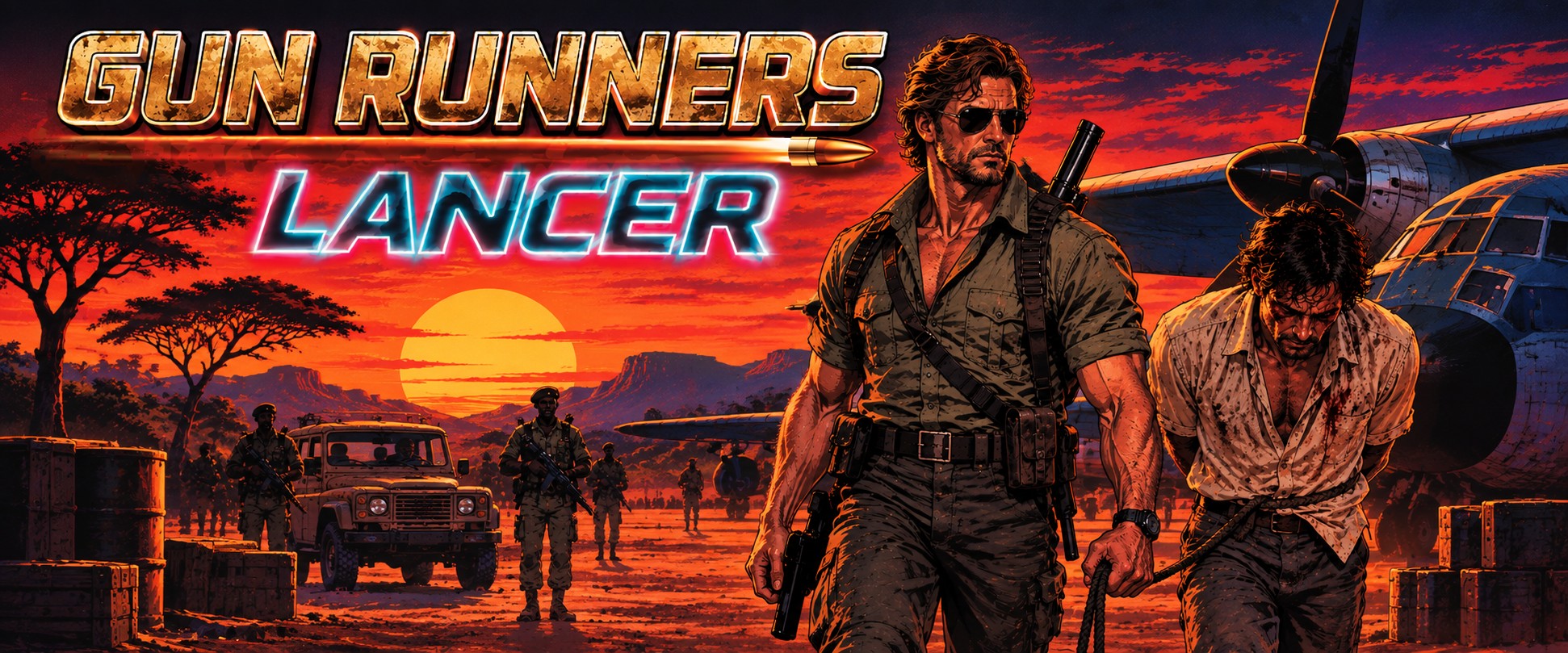
Not every story in the Gun Runners world happens to somebody already in the books. Victor Lancer isn’t a character from the main novels—he’s a new one, a bounty hunter who finds people for money and doesn’t much care why they’re missing, years before the main story begins. Consider this another sighting of an ever-expanding universe.
This free short story ties directly into the wider universe: one long hunt, one very small mining company, in Zaire, 1983. Read it below, free, no strings attached.
The photograph showed Michael Renn beside a drilling rig, smiling at something outside the frame. He wore a white shirt with the sleeves rolled up, and his hand rested on the shoulder of a man somebody had cut out of the picture. Victor Lancer turned it over. A date, a company stamp, nothing else. Across the hotel table, Adrian Steen watched him through the smoke of a cigarette while the ceiling fan pushed warm air around the room.
“He disappeared six months ago,” Steen said. “Company vehicle, company money, geological surveys belonging to my employers. The vehicle was recovered. Nothing else was.”
Victor laid the photograph beside his untouched drink. He was a broad man in a pale cotton shirt, with dark glasses folded into the breast pocket and a leather bag standing between his boots. The journey from the airport had left red dust on his trousers. “Who have you sent?”
“A local investigator. Then two men from our security office.”
“What happened to them?”
“The investigator submitted expenses. The security men came back with malaria.”
“Both of them?”
“Same week.”
“Expensive malaria.”
“The investigator’s expenses were worse.”
Victor turned to the window. Beyond the glass, Kinshasa shone in the late afternoon heat: roofs, traffic, the pale breadth of the river. Somewhere below them a driver had been leaning on his horn for most of a minute. “And you want Renn alive.”
“Alive and able to answer questions. We’ll arrange collection at our depot outside Kabalo. There’s an airstrip.”
“Who signs for him?”
“I do.” Steen pushed an envelope across the table. “Ten thousand now. Thirty on delivery. Reasonable expenses.”
Victor opened the envelope and counted the money. Steen waited until he had finished before adding, “Naturally, we expect progress reports. Any indication of his location should be communicated immediately.”
“You’ll get a collection time when I have him.”
“Our people could assist.”
“Then you wouldn’t need me.”
For the first time, Steen’s expression changed. It was slight, a tightening around the mouth, but Victor saw it. He put the envelope in his bag and stood.
Steen tapped ash into the tray. “You haven’t asked what’s on the surveys.”
Victor picked up the photograph. “I haven’t found your engineer yet.”
Renn’s last address was a furnished apartment above a travel agency in Lubumbashi. The company had searched it, the police had searched it, and the landlord had sold most of what remained. Victor found the landlord repainting the kitchen around a square of cleaner wall where a cupboard had stood.
“Three months he owed me,” the landlord said, working the brush along the baseboard. “Three months and a refrigerator. The company took his papers. The police took his radio. I took what was left, which was nothing.”
“Visitors?”
“Women. Drivers from the company. A boy with the bottled water.” He dipped the brush and slapped it against the tin. “Foreigners always have visitors. They never have rent.”
None of that interested Victor as much as the dressmaker across the courtyard, who had watched Renn carry his own trash downstairs every evening for three days before he vanished.
“He used to leave it outside his door,” she told Victor, holding a cigarette away from a half-finished blue dress. “Then suddenly he was a very considerate man.”
“Heavy bags?”
“Heavy enough that he took the stairs one at a time.” She drew on the cigarette. “I thought he had a woman up there he was ashamed of. Turns out he was emptying the place.”
The stolen Land Cruiser sat behind a police garage with its wheels missing. Victor paid to examine it and paid again when the sergeant remembered the key. There was nothing under the seats except grit and a corroded bottle cap. The glove compartment held an empty cigarette packet and a repair receipt made out to Monsieur Lambert.
At the garage named on the receipt, a mechanic remembered the vehicle because Renn had argued over a replacement radiator hose. He remembered the driver because the driver had paid in good money and asked for a bad receipt.
“He wanted the date changed,” the mechanic said.
“Earlier or later?”
“Earlier. Four days.”
“He say why?”
The mechanic wiped his hands on a rag blacker than they were. “He gave me twenty dollars. That was the why. Thin man, nervous. Wore his watch on the inside of his wrist, like a nurse. And he kept rubbing his nose, here, with his thumb, like his glasses hurt him.”
Victor bought two beers from the cooler beside the pit and handed one over. “Say a man wants to leave a car somewhere and keep his luggage.”
“Then he doesn’t leave it here.” The mechanic drank half the bottle in one pull. “He finds a truck going north. Cotton trucks, behind the market. They carry anything that pays.”
By evening Victor had the name of a truck driver. Two days later he had a river landing. Renn had traveled north with a canvas trunk, a fuel drum and a new name.
After that, the trail became a succession of small transactions. A room paid for in advance and abandoned before breakfast. A pair of spectacles repaired with the wrong screw. A mission dispensary where a Belgian called Lambert had bought dressings and quinine, then spent an hour fixing the pump behind the surgery. Victor stopped asking whether people had seen a fugitive. He asked whether anyone had repaired an engine.
The answer took him to a riverboat with blue paint flaking from its wheelhouse and sacks of meal stacked beneath a canvas awning. Its owner, Célestin Banza, studied the photograph without touching it.
“Police?” Banza asked.
“No.”
“His wife?”
“No.”
Banza took in Victor from the boots up: the worn leather, the powerful shoulders, the patient expression. “Then your fare will be expensive.”
Victor put money on the wheelhouse shelf. “Did you carry him?”
“Yes.”
“Where?”
Banza counted the notes. “That answer is also expensive.”
“That answer is also expensive.”
They left at first light.
For three days the boat worked through brown water beneath a sky that seemed to hang just above the trees. Barges passed with washing strung between poles. Children waved from muddy steps. At night, cooking fires glimmered through the vegetation while insects battered the lamp over Banza’s charts. Victor slept on his bag and woke whenever the engine changed its note.
On the second evening Banza talked while he ate, picking fish from the bone with his fingers. “Your man asked too many questions about the eastern bank. Which landings still serve the old mining tracks. Whether the railway takes passengers. Who sells diesel away from the big towns.”
“What did you tell him?”
“What he paid for.” Banza flicked a bone over the rail. “I put him ashore with his trunk where there is nothing to see from the water. Then he paid another boatman to take him farther north.”
“Did he go?”
“No. The boatman’s nephew took his money and drank it. Your man walked east.”
Victor pulled the chart under the lamp. The company believed Renn was trying to leave the country. Everything Victor had found said the opposite. The engineer had abandoned the easiest routes out and paid to make people remember journeys he had never taken.
“What’s east?”
Banza rested a thick finger on an unmarked stretch of paper. “People. Old workings. Roads that used to be roads.”
“Can you wait at the landing?”
“For how long?”
“Four days.”
Banza shook his head. “Two. On the third morning, I leave. I have customers who don’t need handcuffs.”
Victor had not mentioned handcuffs.
The settlement stood around an old pumping station, its corrugated roofs stained orange by the earth. A stationary conveyor reached into the trees. Beneath it, women sorted cassava into baskets while two boys struggled with a bicycle wheel. Somewhere an engine coughed, caught, and settled into an uneven rattle.
Victor came in on the back of a produce truck. His sleeves were rolled above the elbows, his shirt dark with sweat beneath the straps of his bag. A woman behind a plank counter sold him a bottle of beer.
“No cold,” she said, before he could ask. “Cold is for the city.”
He took it warm, found a stool in the shade and watched the water tank at the end of the street.
Michael Renn emerged from the pump house carrying a wrench.
He had grown a beard and lost weight. His hair was longer than in the photograph, his shirt patched at one shoulder. But he still wore his wristwatch turned inward, and when he stopped beside the tank he rubbed his thumb along the bridge of his nose exactly as the mechanic had described.
Victor finished the beer.
He waited until Renn went back inside, then crossed the yard and stepped through the doorway. The pump house stank of diesel and hot metal. Renn was bent over a coupling with his back to the entrance.
“You’ve got a leak under the return pipe,” Victor said in French.
Renn straightened. His eyes went first to Victor’s face and then to the doorway behind him. “Who are you?”
“Victor Lancer. Put the wrench down.”
Renn threw it.
Victor moved his head. The tool struck the doorframe hard enough to split wood, and Renn came after it with surprising speed. Victor caught him high in the shirt, turned, and drove him against the tank housing. Renn’s elbow struck Victor’s cheek. His next blow never landed. Victor folded his arm behind him and pressed his face against warm steel.
“Easy,” Victor said. “You’re the part I need working.”
Renn stamped backwards at his knee. Victor cranked the arm higher until the engineer quit fighting. A minute later Renn sat on an upturned crate with his wrists cuffed in front of him and blood running from his nose onto his shirt.
A woman stood in the doorway. She was perhaps forty, wearing a faded green dress and heavy work shoes, and she held the wrench Renn had thrown.
“Let him go,” she said.
Victor kept one hand on Renn’s shoulder. “Who are you?”
“Thérèse Ilunga. He keeps our water running.”
“Can somebody else do it?”
“You break into our pump house and ask about maintenance?”
“I’m asking who fixes it after he’s gone.”
Renn lifted his head. “Thérèse, tell Joseph to bring the men.”
Victor pulled the engineer upright before she could answer. “Tell Joseph there’s trouble coming if he gets involved.”
Her eyes went from the cuffs to Renn. Her anger sharpened into something more considered. “You said they wouldn’t come here.”
“I didn’t know,” Renn said.
Victor jerked his chin at the door. “Get your things.”
Renn laughed once, painfully. “You really don’t know who sent you.”
“I know where you’re going.”
Thérèse stayed in the doorway. Outside, the engine kept up its rough, stubborn beat. “He has papers. About this place.”
“Thérèse,” Renn warned.
She ignored him. “Show him.”
Renn’s room was behind the disused company office. A mosquito net hung over the bed, and a shirt dried on the sill beside a dismantled radio. Under the bed Victor found the canvas trunk. Inside were clothes, surveying instruments and a flat tin case wrapped in oilcloth.
There were two sets of maps. Even without knowing the symbols, Victor could see the difference. One showed a cluster of settlements above a colored mineral seam. The other showed the seam shifted several miles and the settlements missing altogether.
Renn sat on the bed while Victor examined them. “The official survey declares the concession unoccupied. Once the paperwork is accepted, they can clear it. No compensation. No witnesses worth listening to. The real deposit runs directly beneath three villages.”
“And you took the originals.”
“I made the originals.”
Victor lifted his eyes from the maps.
Renn managed a second of it, then found the window instead. “I corrected them.”
Thérèse folded her arms. “He came to tell us. He stayed when the pump failed.”
From the trunk, Victor took a second envelope containing carbon copies of letters and payment schedules. Renn leaned forward.
“Those aren’t relevant.”
Victor read the first page. Then the second. The payments bore Renn’s signature.
“You were paid to move the seam.”
“I was told the land was empty.”
“On the map you drew?”
Renn’s face hardened. “You think you’re the first man to take money without asking enough questions?”
Victor closed the case and slipped it into his bag. Outside, someone called Thérèse’s name. She went to the window, spoke to a man below, and turned back.
“A company vehicle came to the southern crossing yesterday,” she said. “Four men asking for the road. Joseph told them the bridge was down.”
“Is it?”
“Yes. They’ll have to use the long road.”
Victor turned to Renn. Finding him had taken nineteen days. Other people were evidently less patient.
“How long?” he asked Thérèse.
“Until morning, if they know the way.”
Victor took the engineer by the arm. “Then we’re leaving now.”
Renn waited until the settlement had disappeared behind them. “Fifty thousand dollars.”
Victor walked on.
“Seventy-five.”
“Where is it?”
“Brussels.”
Half a mile later Renn tried again. “A hundred thousand.”
“Also in Brussels?”
Renn shoved his glasses up his nose with both cuffed hands. “I’d have to telephone someone.”
“Tell me when you find a telephone.”
The track narrowed beneath the trees. Heat clung to their clothes, and the cuffs clicked whenever Renn stumbled. Victor had bought a short, battered rifle from Joseph and carried it on a canvas sling. His bag rode against one hip; Renn’s water bottle knocked against the other.
Near dusk they reached a stream where a fallen tree served as a bridge. Victor let Renn drink, checked his wrists and tightened the loose screw on the engineer’s spectacles with the tip of his pocketknife.
“They’ll kill me,” Renn said.
“Then why do they want you alive?”
“Because they need to know who else has copies.”
“Who else does?”
Renn wiped water off his chin with the back of his cuffed hands.
Victor handed back the glasses. “That’s what I thought.”
They reached Banza’s landing after midnight. The boat was there, but the canvas awning had been taken down and the engine was warm. Banza stood in the wheelhouse doorway with a shotgun held against his leg.
“You are late,” he said.
“It’s the second night.”
“It has been a busy second night. Two men came this afternoon with money, photographs, questions. They offered me more to sit here than you paid me for the whole river.”
“Where are they?”
“One went to fetch their vehicle. One stayed.” Banza pointed the shotgun toward the bank. “He is tied behind the fuel shed. I don’t like men looking through my things.”
Victor jerked a thumb at Renn. “Neither do I.”
They cast off into darkness.
By morning Renn had tried to bribe Banza, persuade a deckhand that Victor was a kidnapper, and work a length of wire out of a broken basket. Victor pried the wire from his fingers and dropped it over the side.
“My deckhand says you are a kidnapper,” Banza said.
“Close enough.”
At the next landing Victor paid Banza, bought food, and hired a truck from a trader named Mbuyi, who insisted on coming with it.
“My nephew drives badly,” Mbuyi explained. “You look expensive to bury.”
The truck had a blue cab, one yellow door and a windshield cracked from corner to corner. Mbuyi drove with both hands low on the wheel while Victor sat beside him and Renn occupied the space between them, cuffed to a steel bracket beneath the dashboard.
For the first hour the engineer watched the trees go by. Then he began giving directions.
“The road ahead is washed out.”
Mbuyi kept his foot down.
“There’s a company station west of here. Radio, fuel, beds. You could call your employer.”
Victor turned his head. Renn was busy with the scenery.
“Who’s at the station?”
“People who can end this ridiculous journey.”
“Friends of yours?”
“People who know me.”
Mbuyi spat through the open window. “We keep going.”
By noon the forest had opened into a broad stretch of churned earth. A timber barrier lay across the road ahead. Two men in military shirts stood beside a parked truck, and a third sat beneath an umbrella with a bottle between his boots. Victor saw no insignia he recognized. More usefully, he saw the seated man stand when he noticed Renn.
Renn drew breath.
Victor caught him by the back of the neck and forced his head below the dashboard as the first shot punched through the windshield.
Mbuyi hauled the wheel sideways. The truck dropped into a drainage rut with a crash that drove Victor’s shoulder against the door. Another shot tore through the roof. Renn screamed beneath the dashboard while Victor kicked his door open and slid into the mud.
The rifle came off his shoulder. He fired twice toward the barrier. One man fell back against a wheel; the other vanished beneath the chassis.
Mbuyi was already out on the far side of the cab, swearing in two languages. “Your passenger knows them!”
Victor reached through the open door, unlocked the cuff from the bracket and dragged Renn out by the shirt. The engineer landed on his knees. Beyond the hood, the man from the umbrella was running for the trees with a Makarov in his hand.
Victor fired. The man dropped and rolled out of sight.
“Get behind the truck,” Victor told Renn.
Renn lunged for the open ground.
Victor caught the chain between his wrists and jerked him backwards so hard they both went down. A burst of gunfire struck the yellow door where Renn’s head had been. Victor rolled over him, brought the rifle up and fired under the parked truck until the shooting stopped.
For a few seconds there was only the ticking engine and Mbuyi’s breathing.
Then gasoline began dripping from Mbuyi’s truck.
Mbuyi stared at it. His face had changed completely. “You owe me a vehicle.”
Victor hauled Renn to his feet. “Get your money out of the cab.”
They abandoned the truck before the leaking fuel found anything hot enough to ignite it. There was no explosion. Somehow that made Mbuyi angrier.
“A fire, I could tell people about,” he said. “This, I just look stupid.”
Where the road met the railway, Victor counted dollars from Steen’s advance into the trader’s hand.
“That buys a truck,” Victor said.
Mbuyi folded the notes into his shoe. “It buys a truck. It doesn’t buy me liking you.”
He went south on foot. Victor and Renn followed the rails.
They sheltered that night in the remains of a railway maintenance building. Rain hammered the roof while water dripped through a dozen rusted holes.
Victor sat against the wall and pulled his shirt away from his upper arm. A bullet had cut a shallow groove through the flesh. Dried blood glued the cloth to it.
Renn watched from the opposite wall. “You’ll need that cleaned.”
Victor placed the water bottle and dressings between them, then held out the cuff key. He uncuffed one wrist and looped the loose bracelet around an iron pipe.
The engineer worked carefully, washing grit from the wound with water from the bottle. “What are they paying you?”
“Forty.”
“Thousand?” Renn snorted. “They spent more than that on helicopter hire for the first survey.”
“Then I should have charged more.”
Renn tightened the bandage with more strength than his thin wrists suggested. Victor watched the rain coming through the roof. “You could have stayed in Europe.”
“You could have stayed in Europe.”
Renn gave a tired smile. “So could you.”
“Why come back to the villages?”
For a while Renn concentrated on tying off the bandage. “There was a man on the first survey team. Pascal. He drove us, translated, found workers. He was from one of the places they intended to remove. I told him the company would pay everyone properly.”
“What happened?”
“He went to the district office with a copy of my map. Three days later they brought his bicycle home.” Renn sat back. “I’d already taken the money. I thought if I brought the originals here, if enough people saw them, they couldn’t simply make the place disappear.”
Victor nudged the tin case beside his bag with one boot. “But you didn’t give them the papers.”
“I showed them.”
“You kept the originals under your bed.”
“They were the only protection I had.”
Outside, rain hissed through the grass between the rails. Renn studied the dressing on Victor’s arm.
“They’ll put me on a plane. There’ll be a room somewhere. Steen will ask his questions until he believes the answers. After that, I don’t know.”
Victor buttoned his shirt.
“You can still let me go,” Renn said.
“Yes.”
The answer seemed to hurt him more than an argument would have. He leaned back against the wall and closed his eyes.
The rails led them to a siding where a diesel works trolley sat beneath a tarpaulin. Its owner was an old railway fitter with cataracts and a transistor radio held together by string.
“South,” Victor told him. “As far as the freight yard. You get it back.”
The fitter held a twenty close to his clouded eyes, as if he could read it by the light coming through. “I get it back, or I get the rest.” Then he dragged the tarpaulin off.
“Brakes work?”
The fitter considered the trolley. “Enough.”
They traveled south with Renn sitting on a toolbox between Victor’s boots. Trees crowded the line, brushing the sides. In places the track sagged into black water; in others, sunlight flooded through gaps in the canopy and turned the rusted rails white. The trolley rattled so violently that Renn had to shout.
“You’ve spent half your fee.”
Victor kept his hand on the brake lever. “You’ve been expensive.”
“Was I worth it?”
“Ask me when I’ve been paid.”
Late in the afternoon they reached a freight yard with a working radio. The operator was a young man in a Kinshasa football shirt, eating peanuts from a twist of newspaper.
“Twenty minutes,” he said, pocketing Victor’s money. “After that the Lubumbashi traffic comes on and everybody hears everything.”
He went outside to finish his peanuts. Victor contacted the company depot.
Steen answered after eleven minutes.
“I have Renn,” Victor said. “Tomorrow morning. Seven.”
Steen’s voice came thin through the static. “Where are you?”
“Close enough.”
“We can send a vehicle.”
“I’ve tried your vehicles.”
Silence flattened the static.
Victor stood with the microphone in one hand, watching Renn through the office window. “Your people opened fire on a truck carrying your engineer.”
“I have no knowledge of that.”
“Then find out before morning. Balance in cash. You sign the receipt yourself.”
“Does he have the documents?”
Victor kept his thumb off the transmit key and watched Renn pick grit from under his fingernails.
Steen’s voice cooled. “Mr. Lancer?”
“You hired me to deliver a man. If anything else needs discussing, we’ll discuss it there.”
The depot lay beyond a belt of scrub beside a dirt airstrip. Fuel drums stood in rows under a sheet-metal roof. A twin-engined aircraft waited near the hangar, its pale fuselage filmed with dust.
Victor arrived in a borrowed pickup at six fifty-five.
Renn sat beside him with his hands cuffed and his shirt washed clean of most of the blood. Victor had shaved at the freight yard. His dark glasses hid his eyes, and the dressing beneath his sleeve made one arm look thicker than the other.
Steen stood outside the office with a briefcase. Two guards waited behind him. A third man, heavy through the chest and neck, leaned against a Land Rover smoking a cigarette. Renn saw him and pressed back into the seat.
“That’s Decker.”
Victor stopped the pickup. “Security?”
“Head of it.”
Decker dropped the cigarette and crushed it beneath his boot. “You made a hell of a mess getting here.”
Victor got out and brought Renn around the front of the vehicle. “You should see the truck.”
Steen’s gaze moved over the prisoner, checking the face against memory. “Michael.”
Renn found something interesting in the dust on his shoes.
“Money,” Victor said.
Steen opened the briefcase on the hood. Bundles of dollars lay inside. Victor checked them while Decker watched the bag hanging from his shoulder.
“The survey case,” Decker said.
Victor closed the briefcase. “In the pickup.”
“Get it.”
“After he signs.”
Steen took the receipt. It was a single typed page identifying Michael Renn and acknowledging his delivery alive. He read it twice, perhaps expecting something clever. There was nothing clever on it.
He signed.
Victor folded the paper into his breast pocket, took his hand from Renn’s arm and stepped back.
Renn stayed where he had been left, cuffed hands hanging in front of him. Then one of the guards came forward and took hold of him.
Renn turned to Victor. “That’s it?”
Victor picked up the briefcase. “That’s it.”
Decker crossed to the pickup and pulled the tin case from behind the seat. He opened it on the hood. The maps were inside, along with the letters and payment schedules. He flicked through them, then raised his head.
“Where are the negatives?”
Renn’s expression changed before he could stop it.
Victor set the money down beside his boot.
Decker caught the movement. “What did you do?”
“Photographed the papers at the freight office. Renn showed me which details mattered.”
Steen turned toward his prisoner. Renn was staring at Victor now, just as surprised as the others.
“Who has the film?” Steen asked.
“On its way to Brussels. Addressed to a lawyer whose name appears in your own correspondence.”
Decker’s hand moved toward his belt.
Victor’s Colt Commander was already out. He held it low against the side of his leg, the muzzle pointing directly at Decker’s middle. The guards tightened their grips on their rifles.
“Leave it,” Steen said.
Decker stopped.
Victor shifted his attention to Steen. “Your lawyer can decide what to do with your maps. I’ve included the payment records. That gives him something to think about.”
Steen tipped his head toward Renn. “You imagine this protects him?”
“No. It means killing him won’t recover the information.”
Steen studied Victor. The aircraft door stood open behind him. Somewhere inside the hangar, a mechanic dropped a tool.
“You’ve interfered in company business.”
“Your men shot at me.”
“You’ve been paid extremely well.”
Victor picked up the briefcase with his free hand. “Eventually.”
He backed toward the pickup. Decker’s face had gone a deep, ugly red, but Steen had begun reading the first page of the payment schedule. Whatever he saw there, he gave no order.
Renn called out as Victor opened the door. “Lancer.”
Victor stopped with one boot on the sill.
“Did you really send it?”
“Yes.”
“Then why bring me here?”
Victor rested his hand on the door. Behind Renn, the guard was waiting to lead him toward the aircraft.
“Because I took the job.”
“Because I took the job.”
He got into the pickup, laid the Colt on his thigh and drove out.
At the freight yard he returned the vehicle, settled the remaining accounts and bought a seat on the next westbound service. His arm had started throbbing again. He sat beneath the station awning with his bag between his feet and the briefcase tucked behind his boots.
A boy brought him a bottle of orange soda. Victor paid, then took out his notebook.
Banza’s balance. Mbuyi’s truck. Joseph’s rifle. Railway trolley. Film, processing, postage. Beneath the figures he wrote the name of the pumping settlement and the cost of a replacement coupling. Thérèse had told him the size while Renn packed his clothes. He had remembered.
The train arrived in a wash of heat and brake dust. Victor boarded, found his compartment and set the briefcase on the opposite seat.
Inside his shirt pocket, Steen’s receipt had softened with sweat. He unfolded it, checked the signature once more and placed it in the notebook beside Michael Renn’s photograph.
The engineer still smiled beside the drilling rig, his hand resting on a shoulder outside the frame.
Victor closed the book as the train began to move.
Victor Lancer will turn up again as the Gun Runners universe grows. In the meantime, the story that started it all—Gun Runners—is out now in paperback, hardback, and on Kindle, worldwide.