GUN RUNNERS: GRAVEYARD SHIFT
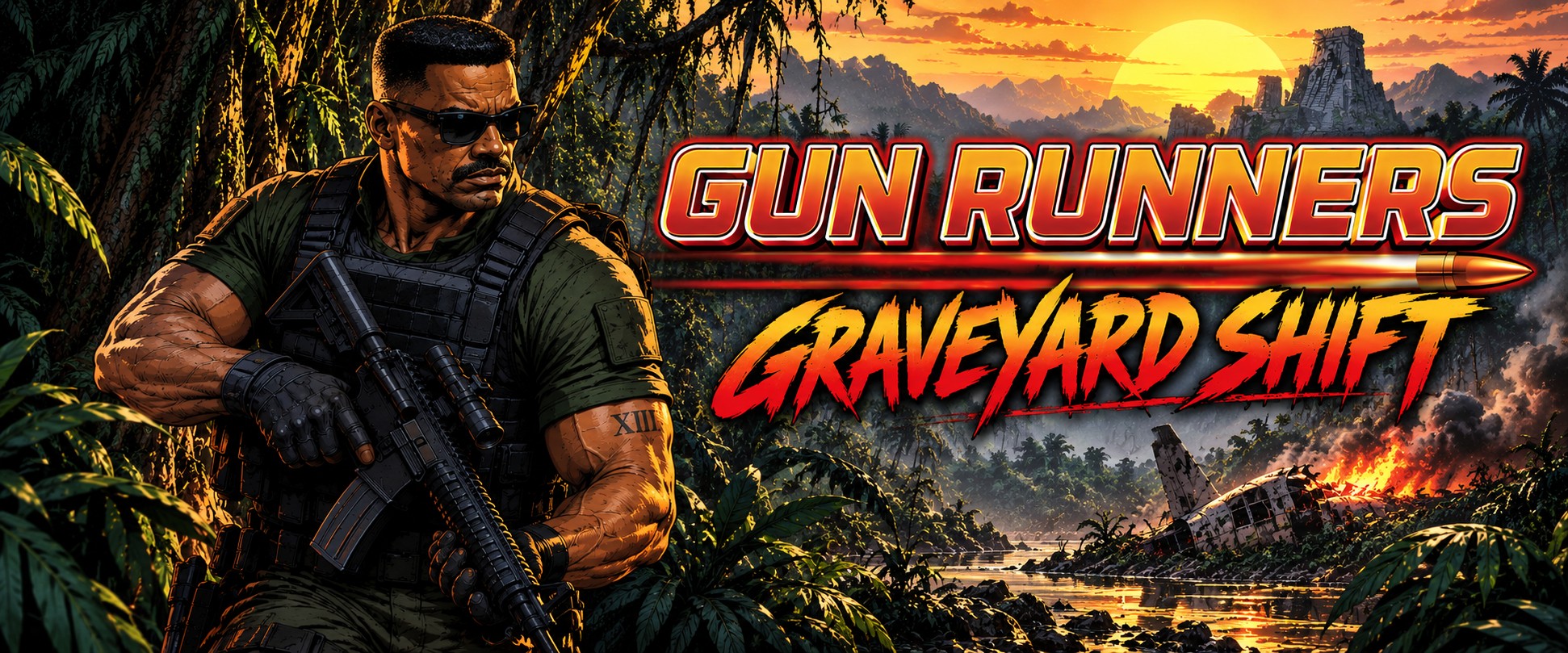
Not every story in the Gun Runners world happens to somebody already in the books. Derrick Ryker—a mercenary known in certain circles as Graveyard—is a new addition to the universe, working jungle recovery jobs years before the main story begins. Consider this the first sighting of an ever-expanding universe.
This free short story ties directly into the wider universe: one job, gone very wrong, in Central America, 1984. Read it below, free, no strings attached.
The Cessna was still moving when Derrick Ryker opened the door.
Hot air slammed into the cabin, thick with river water, vegetation and aviation fuel.
Beyond the spinning propeller, a dirt strip ran between a brown river and a wall of jungle.
The pilot braked hard enough to bring Ryker's pack against the back of his legs.
The pilot looked across. “You planning on waiting until I stop?”
He had a sunburnt neck, a wedding ring on a chain and the uneasy cheerfulness of a man being paid more than usual.
His name was Bell, according to the license clipped above his head.
Ryker lifted the pack. “You planning on stopping?”
He stepped down when the wheels stopped turning, cleared the wing and checked both ends of the strip.
Nothing stood there except a leaning windsock and a fuel drum somebody had used for target practice.
Bell leaned across the empty seat. “Forty-eight hours. Same place. If the weather closes in, I'll make another pass when it clears.”
He glanced at the rifle across Ryker's chest. “Assuming you're still here.”
Ryker checked his watch. Wednesday, 14:07.
“Friday. Fourteen hundred. Circle before you land.”
He settled the pack on his shoulders and pulled the loose end of a strap flat.
“You worried I'll forget?” Bell asked.
His smile looked less convincing from the ground.
“I'm worried you won't,” Ryker said.
He turned towards the trees before Bell could decide what that meant.
Behind him, the Cessna accelerated and lifted away over the river, leaving the air full of dust and the diminishing complaint of its engine.
Ryker watched until it disappeared.
Then he took off his sunglasses, wiped them and put them in a shirt pocket.
The jungle replaced the aircraft with cicadas, monkeys and water dripping through leaves.
He stood long enough to hear the separate sounds before he stepped beneath the canopy.
Twenty thousand dollars bought the recovery of one black briefcase from a crashed courier plane.
“Twenty thousand dollars bought the recovery of one black briefcase from a crashed courier plane.”
The wreck lay roughly twelve miles northwest, according to a survey pilot who had seen broken treetops and a flash of aluminum.
Ryker had a marked map, a photograph of the case and a check he could cash on delivery.
The man who had hired him, an American named Halloway, had described the contents as commercial papers belonging to his employer, Henry Draven.
Halloway had talked about confidentiality for eleven minutes in a hotel bar with no other customers.
He had said very little about the courier and nothing about the pilot.
Ryker had asked whether anyone else was looking for the aircraft.
Halloway had answered that the area was remote, which was not an answer.
By five o'clock, Ryker knew why.
Bootprints crossed a muddy game trail beside a fallen kapok, several sets laid over one another and all heading towards the reported wreck.
One man dragged his right heel; another wore a sole split across the ball of the foot.
Ryker could separate six men with confidence, possibly a seventh.
He stepped back into his own prints and took a line west, adding distance to put the trail off his right shoulder.
The heat stayed with him under the trees.
Sweat collected beneath his vest and worked down his spine, while vines caught at his sleeves with the persistence of hands.
He stopped at a stream, checked the banks before crossing and drank from his canteen on the other side.
The map showed an old logging road running towards the river.
On the ground, thirty feet of green growth hid everything except one collapsed culvert.
Rain began before dusk, heavy enough to flatten the undergrowth.
Ryker covered the map and kept moving, slower now, reading the terrain where he could no longer read the sky.
At 19:32 he found a wheel assembly hanging in vines above his head.
Farther on, a strip of torn metal had shaved the bark from three trees before burying itself in a fourth.
The courier plane lay in a shallow ravine.
Its nose had folded against a trunk, and one wing was gone beyond the engine mounting.
Rain struck the exposed cabin with a hollow ticking.
Ryker watched from above until he was satisfied that nobody was watching back, then worked down behind the broken tail.
The cargo door had been opened from outside.
Mud marked the sill and the floor, and a length of cut leather lay beside an overturned seat.
The pilot was dead at the controls.
A second man in a white shirt had been thrown against the forward bulkhead; beneath his open jacket was an empty shoulder holster.
Ryker checked the passenger's pockets.
The passport named him Daniel Colston, and a card identified him as an accountant for Draven Tropical Holdings.
There were keys, some money and a folded letter addressed to a newspaper in Panama City.
Ryker put the letter and identification in a waterproof pocket.
The briefcase was gone.
Outside, two cartridge cases shone in the mud beside the wing root.
He had seen no bullet wounds on either dead man.
A handprint marked the fuselage farther aft, its reddish edges thinning under the rain, and a broken fern pointed away from the ravine.
He followed the disturbance until an old revolver appeared between two leaves.
“Stay there,” a woman said.
Her voice was low and strained. “I know where your heart is.”
Ryker stopped with his hands clear of the rifle. “Then we understand each other.”
He could see one eye, wet black hair and a cut above her eyebrow.
The revolver trembled, but its muzzle remained on his chest.
The woman shifted behind the leaves and stifled a cry.
A curved panel from the aircraft lay across her lower leg, trapped beneath a fallen branch.
She had crawled into shelter and brought part of it down on herself.
Blood had soaked through the torn knee of her trousers.
“I can lift that,” Ryker said.
He waited until she looked at the metal. “You keep the gun pointed away from me while I do it.”
"Are you with them?" she asked. Her eyes went to his rifle and back to his face. "The men who came."
“They got here first,” Ryker said.
He lowered himself slowly and tested the panel without lifting it. “If I were with them, I wouldn't be following their tracks.”
She considered that, then moved the muzzle aside.
Ryker worked the branch clear and raised the panel enough for her to pull free.
When her leg moved, he let the metal settle gently instead of dropping it.
She kept the revolver in her lap while he opened a dressing.
"Ana Morales," she said, watching his hands. "My name. In case you were going to ask."
“Ryker,” he said.
He washed mud from the cut with a little clean water, then bound it.
The ankle moved, and she could put weight on the leg, although doing it cost her.
He handed over the canteen and waited while she drank.
Ana nodded towards the wreck. “It came over San Esteban this morning. Part of the wing hit our storehouse. My brother went after the plane to help.”
She swallowed and looked away. “I followed him. By the time I reached him, the others were there.”
Ryker took the canteen back. "How many?" He watched her face rather than the gun.
“Seven came through the village. Serrano was one of them.”
Ana pressed her lips together. “They found a black case. Mateo had pulled it away from the fuel because he thought something might burn. Serrano wanted to know if he had opened it.”
"Did he?" Ryker asked. He put the dressing wrapper into his pocket.
“He said no. They kept asking.”
Ana's grip tightened on the revolver. “I shouted, and one of them shot at me. I ran. When I came back, they had taken him. I tried to find somewhere they wouldn't see me if they returned.”
Ryker looked towards the trail.
Taking a witness bought Serrano time to discover what the witness knew; taking somebody local discouraged the village from interfering.
Neither reason gave Mateo much of a future once the case was sold.
Ryker folded the remaining dressing and returned it to his pack.
"Where did they go?" he asked.
“The old logging camp. Los Jaguares use it now.”
Ana pulled herself upright against a tree. “I can show you.”
“You can point,” Ryker said. “I'm here for the case.”
He checked that she could stand without the tree, then picked up his rifle.
Ana stared at him. “He's sixteen. He heard an airplane crash and went to help somebody.”
“He’s sixteen. He heard an airplane crash and went to help somebody. You can at least look.”
She did not raise her voice. “You're going to the same place. You can at least look.”
Ryker started towards the ridge and stopped beside the broken fern.
Behind him, she was trying to make her injured foot accept her weight.
He looked at his watch, then at the dark ground ahead.
There was no sense sending her alone through country occupied by the men who had shot at her.
"How far?" he asked.
Ana steadied herself. “Four kilometers by the old road. Less by the creek, but we can't use that after this rain.”
She tucked the revolver into her waistband. “My father worked there. I know another way.”
Ryker took a strip of cloth from his pack and covered the bright buckle on her belt. “Show me. When I stop, you stop.”
He waited for her nod before adding, “And don't point that thing at me again.”
They reached the ridge above the camp shortly after midnight.
The rain had eased to a steady dripping, and the clearing below shone under bare electric bulbs.
An office stood on concrete piers at the lower end, with a cookhouse opposite and a maintenance shed built into the rising ground.
Two trucks faced downhill beside the shed.
Ryker settled behind a screen of ferns and counted.
A man walked the perimeter; another sat by a portable generator.
Two played cards beneath the cookhouse awning, one stood outside the office and one watched from a loading platform.
A seventh came out of the maintenance shed carrying a tin mug.
Serrano followed him, tall and clean in a pale shirt, with a pistol riding low on his right hip.
Ana touched Ryker's sleeve and pointed at Serrano. “That's him. There were only seven at the plane.”
She shifted carefully to spare her leg.
"One stayed home," Ryker said. He passed her the binoculars. "Find your brother."
While Ana searched, Ryker studied what the loggers had left behind.
A conveyor ran from the upper yard towards the loading platform, its belt sagging between rollers.
Above it, peeled trunks filled a timber rack on an incline.
A retaining gate held the lower row, with a heavy cable running back to a winch beside a small control shelter.
The buildings had weathered for years, but wheel ruts cut through fresh mud near the timber.
Several logs showed pale ends.
Someone was using the old camp for more than sleeping and storing stolen goods.
Ryker watched the platform guard cross the bottom of the incline and noted the narrow concrete recess behind the winch housing.
Ana lowered the binoculars. “Office. Back room. I saw his shirt when the guard opened the door.”
She took a breath through her nose. “He's sitting up.”
"What's behind it?" Ryker asked.
“A drain runs under the floor. We used to crawl through when my father was working.”
Ana studied the clearing again. “It comes out below the back wall. The room was where they kept wages.”
Ryker looked at her. "How old were you?"
“Eight,” Ana said. “It was big enough.”
After a moment she added, “You might have to breathe out.”
He took the binoculars and watched Serrano enter the maintenance shed.
Through the open door, Ryker saw a desk, a radio and the black case.
Serrano set his mug beside it without looking down.
The case had a pale scrape beneath one metal corner, exactly as it did in Halloway's photograph.
“Wait at the drain mouth,” Ryker told Ana.
He traced the covered route along the bottom of the ridge with one finger. “Stay below the bank. If Mateo comes out, help him downstream to the fallen tree we crossed. If you hear shooting, keep going.”
Ana glanced at the office guard. "And if he doesn't come out?"
“Then you wait,” Ryker said.
He gave her the canteen and his spare dressing. “You know the way to that tree. He'll need somebody there.”
She took them without arguing.
Ryker watched her begin the descent, placing each foot carefully, before turning back to the camp.
He spent another twenty minutes learning the perimeter guard's circuit.
During that time the generator man brought a lamp to the loading platform, and the guard there ran the conveyor briefly to shift a loose length of timber.
Its squeal carried into the trees long after the belt stopped.
Ryker left his pack concealed above the drainage bank, keeping his ammunition and first-aid pouch with him.
He approached the perimeter from the blind side of a derelict bulldozer.
When the walking guard stopped to urinate, Ryker closed the distance and drove him into the soft ground behind its blade.
The struggle was short, ugly and almost lost when the man got a hand beneath him; Ryker trapped it before he could reach his pistol.
He secured the guard, checked that he was breathing and took his radio.
Then he waited beside the bulldozer until his own breathing settled.
The camp carried on around him.
A card slapped a table, and somebody complained about the coffee.
The generator man came looking for his companion several minutes later.
Ryker stayed still until the man saw a boot beyond the blade and hurried towards it.
This time there was less room to struggle.
When it was over, Ryker left both men restrained out of sight, with their weapons somewhere they could not reach.
At the maintenance shed, he found a narrow service passage leading towards the control shelter.
He used it to inspect the winch while Serrano talked on the radio inside.
The mechanism was old but greased; somebody had chalked a recent date on the brake housing.
A long release handle sat behind a hinged cover, within reach of the concrete recess Ryker had seen from the ridge.
He eased the cover open.
There was no reliable way to judge from here how far the logs would travel or whether the gate would fall cleanly.
He looked along the incline, then towards the drain behind the office, which lay well outside its path.
He left the handle alone and moved back towards the trucks.
The nearer truck carried sacks of cement.
The other was empty, parked on a slight gradient above a row of oil drums.
Its door opened with a squeak that made Ryker stop and listen.
Nobody came.
He inspected the cab, then returned to the narrow space behind the shed.
Inside, Serrano's voice became distinct. “Your airplane, your papers. I have expenses too.”
He paused for the reply, turning the volume down before Ryker could make out the words. “Tomorrow morning, then. And nobody comes up my road without telling me.”
Ryker looked through a split board.
Serrano laid the microphone down and rubbed one thumb along the case handle.
The latches were still locked.
He had something he considered too valuable to damage, and he was waiting for somebody who knew what it was worth.
For a moment the room offered itself: one man facing away, a case on a desk and open jungle beyond the service passage.
Ryker could carry it out before the card players finished their hand.
He looked past the shed towards the office instead.
The guard there had drawn his chair close to the door.
Ryker went back to the truck.
A minute later it began rolling towards the drums, gathering speed with nobody behind the wheel.
He was already moving through the service passage when the first shout went up.
The truck struck the drums with a crashing rattle and stopped against the cookhouse steps, tilting the awning over the card table.
Serrano came out of the shed swearing.
The office guard stood to see, and the man on the platform hurried down towards the collision.
Ryker reached the lighting switch on the outside wall and opened it.
The generator continued running, but the clearing went dark.
He dropped below the drainage bank as men began calling for lamps.
Ana was crouched at the mouth, her face a pale oval under the roots.
Ryker touched her shoulder once, then crawled into water cold enough to hurt.
The concrete scraped his vest, and twice he had to turn his head sideways to get through.
At the far end, a loose grille covered a low opening into the office floor.
Beyond it he could see bare feet and the legs of a chair.
He whispered Mateo's name and waited.
The feet withdrew, and a bruised face appeared above the opening.
“Your sister sent me,” Ryker said. “Can you move?”
He braced the grille with one hand to stop it rattling.
Mateo nodded, then swallowed. “They tied my hands. My ribs hurt.”
His voice was rough from either thirst or shouting.
Ryker worked the damaged grille aside far enough to reach through. “Turn around.”
He cut the binding and guided the boy's hands towards the opening. “Your sister's at the other end. Take it slowly.”
Outside, Serrano stopped shouting.
His next order was quiet enough that Ryker barely caught it through the floorboards: check the prisoner.
Footsteps approached across the office.
Mateo looked up, frozen halfway out of the chair, and Ryker caught his shirt.
"Here," Ryker said. "Now."
Mateo lowered himself into the opening as a key scraped in the lock.
Ryker backed along the drain, pulling when the boy caught on broken concrete.
The door opened above them.
A man called out, and then a pistol shot filled the enclosed space with a flat concussion.
Ryker shoved himself backwards into open air and dragged Mateo beneath the bank.
Ana caught her brother before he could fall against the stones.
Another shot struck the water in the drain, spraying their faces.
Ryker checked the boy for a new wound and found none.
“Go,” he told Ana. “Fallen tree. Don't wait for me here.”
He saw her get Mateo's arm across her shoulders, then climbed towards the office corner with his rifle ready.
The guard came around it carrying a lamp and pistol.
Ryker fired before the man could bring the pistol level.
The lamp fell and broke, leaving a small patch of burning fuel in the mud.
Across the camp, somebody fired towards the noise, and bullets ripped through the office wall above Ryker's head.
He stayed below the window line and moved towards the shed.
Serrano had recognized the diversion; his voice called men away from the truck and ordered them to cover the road and office.
That left the narrow service passage empty for a few seconds.
Ryker used them, hearing Ana and Mateo splashing farther down the drain behind him.
He reached the control shelter and started the conveyor.
The motor labored, then the belt moved with the same metallic scream he had heard from the ridge.
A loose board traveled towards the platform and fell with a crack like another shot.
A lamp swung towards the machinery, taking its light away from the shed door.
Ryker entered through the back.
The desk was empty except for the radio, mug and a square of clean wood where the case had been.
He turned at the sound of a shoe on the floor.
The man who had brought the mug was standing in the front doorway with the briefcase in his left hand and a pistol in his right.
The pistol fired as Ryker moved.
The blow against his vest drove him into the desk, knocking the radio onto the floor.
Ryker fired back from where he landed.
The man dropped across the threshold, and the briefcase struck the boards beside him.
For several seconds Ryker could not draw a useful breath.
He kept the rifle on the doorway while his chest tried to work, each shallow movement bringing a new stripe of pain.
His left hand found the impact point.
The vest had held the pistol round, but it had done nothing pleasant with the force behind it.
He got to one knee, picked up the case and moved before the next burst came through the shed.
Splinters struck his cheek.
A round cut his upper arm as he crossed the service passage, and his left hand went briefly weak.
He put the case down behind the winch housing rather than lose it, then dropped into the concrete recess.
From there he could see the lower yard through the legs of the loading platform.
The guard from it lay behind a wheel, firing towards the shed whenever somebody shouted.
The two card players were on the far side of the yard.
Serrano was moving along the near side, using the parked cement truck to cover his approach.
Ryker fired at the platform guard when the man raised his rifle again.
The guard dropped behind the wheel and did not reappear.
One card player ran for the road.
Serrano shouted after him, but the man kept running, and his companion followed into the trees.
Ryker changed magazines with his hands low behind the housing.
He could still hear the conveyor, the generator and water rushing through the drain.
Ana had stopped calling to her brother, which he chose to take as a good sign.
He looked uphill at the timber and checked the edge of the recess with his heel.
Serrano's voice came from the darkness beside the truck. “You've made an expensive mess.”
A beam swept across the winch and rested on the black case. “Leave that and you can walk.”
Ryker said nothing.
He watched the beam while testing his left arm. It would support the rifle, but blood was reaching his wrist.
“Draven is paying me thirty thousand,” Serrano said. “You think he'll pay you after this? He sent you because he didn't want to pay my price.”
The light shifted closer. “Whatever he promised, you're the cheaper option.”
“You should have taken a deposit,” Ryker said.
He moved the case behind his boot and listened for a second pair of feet.
Serrano came around the end of the housing sooner than Ryker expected.
He had left the lamp on the truck and approached beyond its glare, his pistol already aimed.
Ryker's rifle pointed into the yard.
There was no room to turn it before Serrano could fire.
“Put it down,” Serrano said. “Slowly. I know what that vest is, so don't make me choose somewhere else.”
His pale shirt was muddy at one shoulder, but the hand holding the pistol remained steady.
Ryker lowered the rifle into the recess.
Beside him, the opened cover touched his upper arm.
Serrano's eyes flicked to the case and back, and a small change passed across his face.
Recognition pleased him more than the money had.
“Ryker,” Serrano said. “The American told me your name. I thought he couldn't mean the same one.”
He edged nearer, keeping clear of the rifle. “Graveyard. I've heard of you.”
“Graveyard. I’ve heard of you.”
Ryker let his shoulder settle against the housing.
His right hand was level with the long handle beneath the cover.
Behind Serrano, the lowest row of logs rested against the retaining gate, each trunk taller than a man at the thick end.
"Then you should've left," Ryker said.
He pulled the handle and threw himself into the recess.
Serrano fired, the shot striking concrete where Ryker's head had been.
For a terrible moment the winch merely groaned.
Then the drum turned, the gate dropped and the timber moved.
The first trunks struck the loading platform and drove it sideways.
Those behind climbed over them, stripping boards and ironwork into the mud.
Ryker curled around the case with his forearms over his head as the control shelter came apart above him.
Something heavy struck the winch housing hard enough to shake dust from the concrete into his mouth.
Serrano shouted once.
The sound vanished beneath wood striking wood, a deep, rolling violence that went on long after Ryker thought the pile must be empty.
A trunk passed over the recess and lodged against the broken platform.
Smaller pieces followed, rattling down around his boots.
When it stopped, the conveyor was silent.
The generator still ran somewhere beyond the wreckage, making the whole camp sound absurdly ordinary.
Ryker waited until the timber settled again, then pushed himself upright.
His rifle was beneath his leg, its sling trapped under a board; he freed it and checked the action before looking out.
Serrano lay beyond the gate, pinned beneath a trunk.
His pistol was several feet from his open hand.
Ryker watched long enough to establish that there was nothing left to decide, then took the briefcase and worked around the high side of the wreckage.

He retrieved his pack above the drain and went downstream.
Ana stood at the fallen tree with the revolver in both hands.
She lowered it when she recognized him.
Mateo was sitting against the trunk, and the sight of him breathing took one item off Ryker's list.
Ryker put the case down, knelt beside the boy and checked the dressing Ana had made around his cut forearm.
“What was that noise?” Mateo asked.
He watched Ryker's blood fall onto a leaf.
“Logging,” Ryker said.
He tightened the dressing, then held out his good arm to help the boy up. “We're leaving.”
They reached a rocky bend in the river after dawn.
Ryker chose an overhang screened from the water by hanging roots and let Mateo sleep while Ana cleaned his own arm.
The bullet had cut a shallow channel through the muscle.
Every movement pulled at it, and his chest hurt when he breathed deeply, so he avoided doing either more than necessary.
Ana tied the dressing. “You could have left him.”
She kept her eyes on the knot. “I know you could.”
Ryker flexed his fingers. “He would have slowed you down.”
He picked up the briefcase before she could decide whether to answer.
One latch had buckled during the escape.
The other gave after several minutes of patient work.
Ryker opened the lid expecting money, papers or both, and found tightly packed folders under a plastic cover.
There were no banknotes.
He laid the contents on his groundsheet with dry hands.
The first folder held shipping manifests.
The next contained photographs of cut hillsides, trucks carrying enormous trunks and men standing beside burned houses.
Company ledgers filled the space underneath.
Ryker compared the letter from Colston's pocket with the name on the folders, then read the letter all the way through.
Colston had intended to deliver the records to a newspaper editor.
His letter identified the books as originals removed from the regional accounts office and offered to explain the entries in person.
He had written a date and signed beneath it.
The crash had saved Draven the trouble of finding him, provided somebody recovered what he had taken.
Ana drew a photograph closer. “That's Santa Lucía.”
She touched the corner without covering the image. “They told us the people went south for work. My aunt's house was next to the church.”
Ryker found a ledger entry with the same place name.
A payment marked relocation security carried Serrano's initials; another page listed fuel, transport and an allowance for destroyed dwellings.
Attached maps placed the village inside a protected tract.
A later manifest recorded timber from the same area under a different concession number.
Mateo had woken. “They kept asking if I read anything,” he said. “I told them I only moved the case. Serrano said I could tell him properly in the morning.”
He stared at the photograph in Ana's hand and went quiet.
Ryker worked through the remaining pages.
Draven's signature appeared on authorizations, and Halloway's on a cable approving expenses.
There was enough here to give a reporter names to call, accounts to trace and places to visit.
Returning it would leave two dead men in an aircraft and a collection of villages that had supposedly emptied themselves.
Ana watched him take out the check. "That's what they're paying you?"
“Twenty thousand,” Ryker said.
He looked at the amount once, then tore the check across and placed both halves with Colston's letter.
He wrapped the records in the waterproof cover and packed them separately from the case.
"What happens now?" Ana asked. "If we go to the police, Serrano's friends will know before we get home."
“We don't go to the police,” Ryker said. “Colston had an address.”
He closed the empty case. “First we get your brother out.”
They stayed beneath the overhang through the morning.
Ryker slept in short stretches while Ana watched the river, then took over while she rested beside Mateo.
By afternoon the boy could walk with support.
They moved downstream away from the logging road, stopping whenever his breathing shortened, and spent Thursday night above a tributary with no fire.
On Friday, Ryker reached the airstrip early enough to inspect it.
He left Ana and Mateo under cover while he checked the approaches and the ground near the battered fuel drum.
At 13:56 an engine sounded beyond the river.
The Cessna circled once, banked and came in over the water.
Halloway was in the passenger seat.
Ryker watched him climb down in clean trousers and a jacket entirely wrong for the heat.
A bulge beneath the jacket pulled one side lower than the other.
Bell remained at the controls, watching them through the open door.
Halloway looked at the case, then at Ana helping Mateo out of the trees. “Who are they?”
His expression suggested an unexpected charge on a bill.
“Passengers,” Ryker said.
He set the briefcase beside Halloway and motioned Ana towards the rear door. “Bell. The boy needs a doctor.”
Bell looked at Mateo and got out to help him climb aboard.
Halloway bent over the case, opened it and stayed that way for a moment.
When he straightened, the professional warmth from the hotel bar had disappeared.
"Where are the documents?" Halloway asked.
“Lost them,” Ryker said.
He waited beside the wing until Ana had fastened her brother's belt.
Halloway's hand moved towards his jacket. "You were contracted to recover company property."
Ryker looked at the hand. “Leave it there.”
He held Halloway's gaze until the fingers stopped moving. “Colston wrote down what he was carrying. Other people are going to read it.”
Bell stood by the pilot's door. “We're leaving,” he said.
His cheerful manner was gone. “You can come back with us or stay with the luggage.”
Halloway took the empty case aboard.
He sat in the front and did not look round during the flight.
Ryker stayed beside the rear door, one hand resting on his rifle and the other braced against his aching chest.
Below them, the river wound past clearings too small to appear on Halloway's map.
In Panama City, Ryker paid for a clinic and two nights in a room above a bakery.
Ana had a cousin across the border who could take them in while they found out whether San Esteban was safe.
Ryker bought their bus tickets after the doctor cleared Mateo to travel.
He gave Ana the remaining local cash without making an occasion of it.
“You'll need money too,” she said.
She stood outside the bakery holding the tickets, her brother asleep upstairs. “You tore yours up.”
Ryker shifted the bag on his shoulder. “Bad check.”
He glanced towards the bus stop. “Keep him off airplanes for a while.”
He had the records copied in a shop where the owner charged by the page and asked no questions.
One set went to the editor named in Colston's letter.
Copies went to two other newspapers, in separate envelopes, with the relevant photographs and the accountant's signed explanation.
The originals, including the torn check, traveled in the first package.
The editor telephoned a shipping agent before she finished reading.
By the end of the afternoon she had checked one vessel, two dates and the existence of a company that supposedly owned no timber concessions at all.
She put the photographs back in their envelope and called a colleague into her office.
The return-address space on the package was blank.
Four days later, Ryker sat outside a cheap motel near Miami, cleaning dried mud from the stitching of his boots.
His arm had stopped bleeding, although his ribs still objected when he bent.
A radio played behind the office screen, and a bottle of beer sweated on the concrete beside his chair.
For the first time all week, nothing required him to stand up.
The clerk came along the walkway carrying a towel over one shoulder. “Mr. Ryker? Telephone.”
He stopped beside the chair. “Man wouldn't give a name. Says he has a problem that needs taking care of.”
Ryker looked through the office window at the receiver lying beside the register.
He set the brush on his boot and picked up the beer. “Tell him I'm dead.”
Derrick Ryker will turn up again as the Gun Runners universe grows. In the meantime, the story that started it all—Gun Runners—is out now in paperback, hardback, and on Kindle, worldwide.