GUN RUNNERS ATF: THREE MEN DOWN
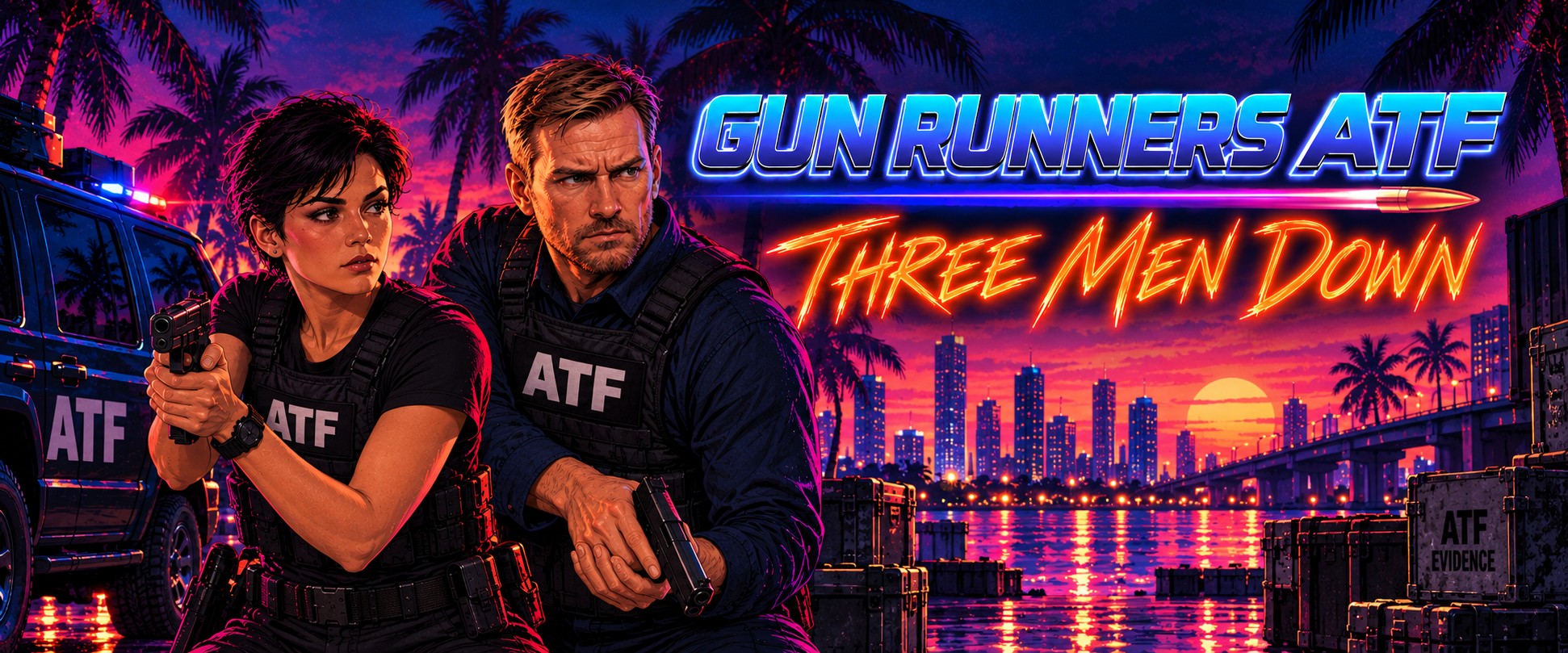
Before Gun Runners ATF reaches Crown Field, Special Agent Carla Ruiz and her new partner Thomas Quinn spend one long day doing the unglamorous part of the job: three nervous men, four recovered guns, and a name that keeps coming up. No shootout, no chase—just paperwork, patience, and a partial license plate.
This free short story feeds directly into the ATF spinoff: one day, three sellers, Miami, 1984. Read it below, free, no strings attached.
Carla Ruiz had fired forty-eight rounds before Thomas Quinn appeared behind the glass.
She knew he was there because his reflection joined hers between shots, tall and broad through the scratched observation window, a paper coffee cup held against his chest. No wave. No knock. Just a big man leaning on the frame with the expression of someone who had come down specifically to ruin somebody else’s morning.
Carla lowered the Smith & Wesson 459, thumbed the safety and laid it on the bench with the muzzle pointing downrange. The paper target hanging twenty-five yards away had a fist-sized hole where its sternum should have been.
Quinn finally pushed through the range door, raising the coffee as though that counted as an apology. “Mathis wants us upstairs.”
Carla pulled off her ear defenders. “I’m booked until eight.”
“Apparently federal investigations outrank your range reservation.”
“They shouldn’t.”
Quinn tipped his cup toward the target. “You planning on leaving any paper for the rest of us?”
Carla ejected the magazine and checked the chamber before setting the weapon down again. “You planning on saying something funny before my slot ends?”
“I thought I just did.”
“You didn’t.”
Quinn took a drink of coffee. “Good. You’re ready.”
Carla turned her head and gave him the full stare.
Quinn smiled. “See? Funny.”
It was 7:43 a.m.
By 7:51, Carla Ruiz’s morning had changed completely.
Theo Mathis had three folders waiting on his desk.
The Miami ATF office was waking up around him. Phones rang beyond the glass. Typewriters hammered. Farther down the corridor, somebody swore at a copier. Morning sun pushed through the blinds in narrow white stripes, cutting Mathis’s office into bands of light and shadow.
Carla took the chair nearest the door. Quinn stayed on his feet until Mathis pointed at the other one.
“Sit, Thomas.”
Quinn sat.
Mathis pushed the first folder across the desk. “Eddie Navarro. Forty-one. Warehouse supervisor. Married, two children, mortgage, no criminal record. Bought six firearms legally over the last four years.”
Carla opened the folder.
Photograph. Address. Employment. Firearms transactions.
Nothing remarkable.
Mathis slid the second file forward. “Raymond Dorsey. Thirty-eight. Owns Dorsey Automotive on Northwest Twenty-Seventh. One arrest for disorderly conduct in seventy-nine. Charges dropped.”
The third followed.
“Luis Calderón. Thirty-five. Electrical contractor. Clean record.”
Quinn leaned forward. “What’s the connection?”
“Guns.”
That got his attention.
Mathis opened another folder, this one a lot thicker. “Metro-Dade recovered a Smith & Wesson during a narcotics arrest two weeks ago. Trace came back to Navarro. He says he sold it privately seven months ago. Last week another handgun turned up during a robbery investigation. Originally purchased by Dorsey. Yesterday Fort Lauderdale sent us two serial numbers. One traces to Calderón. The other belongs to Navarro.”
Carla was already running down the purchase dates. “Same dealer?”
“No.”
“Same model?”
“No.”
“Purchases close together?”
“Sometimes.”
Quinn rubbed his jaw. “So maybe three guys sold some guns.”
“Maybe.”
Carla lifted her eyes from the file.
Mathis was watching her.
That meant there was another page.
Carla turned it.
Three photocopied interview summaries lay underneath.
She read Navarro’s first.
Then Dorsey’s.
Then Calderón’s.
Quinn reached across. “What?”
Carla handed him the pages. “Read how they describe the sales.”
Quinn did.
Navarro had sold his handgun to a man he knew socially. Cash transaction. No receipt.
Dorsey had sold his handgun to a man he knew socially. Cash transaction. No receipt.
Calderón had sold two firearms to a man he knew socially.
Cash transaction.
No receipt.
Quinn lowered the pages. “That’s either coincidence or somebody handed them the same hymn sheet.”
“That’s either coincidence or somebody handed them the same hymn sheet.”
Mathis tapped the desk with one finger. “That’s what you’re finding out.”
Carla closed Navarro’s folder. “Are they suspects?”
“They’re three men attached to four recovered firearms. Right now, they’re people we need to talk to.”
“Together?”
“Separately.”
Quinn stood. “Where first?”
Mathis turned to Carla. “Your call.”
Carla ran a finger down the addresses.
Navarro worked at a freight warehouse near the river. Calderón had a job site in Coral Gables. Dorsey’s automotive shop sat between the two.
She tapped Navarro’s file. “Start where the guns started.”
Mathis gave one short nod. “Keep it quiet.”
Quinn picked up his coffee.
Mathis eyed the cup. “And get her one.”
Carla stood. “I don’t drink coffee.”
Quinn stopped at the door. “Now I’m suspicious.”
Eddie Navarro matched his file photograph, only more tired.
They found him under a corrugated-steel awning behind a freight warehouse, clipboard in one hand, sweat already darkening the collar of his pale blue work shirt. Forklifts beeped behind him. Trucks growled through the loading bays. The Miami morning had barely started and the heat was already climbing.
Quinn did the talking.
Carla watched.
It became their rhythm almost immediately.
Quinn could make an interview feel like two strangers chatting at a bus stop. He smiled just enough. Asked questions without making them sound like accusations. Knew when to shut up and let the other man fill the gap.
Carla studied hands.
Eyes.
Breathing.
Where a man’s gaze went before he answered.
Navarro’s went to Quinn when he knew the answer.
It dropped to the ground when he didn’t like the answer.
“His name was Frankie,” Navarro said.
Quinn rested one shoulder against a loading post. “Frankie what?”
“Salazar.”
“You know him well?”
“Not really.”
Navarro’s right thumb rubbed across the edge of his clipboard.
Quinn caught it too and kept smiling. “Where’d you meet Frankie?”
“Range.”
“What range?”
Navarro hesitated. A forklift reversed past, beeping, and he waited for it to finish.
“South Coast Shooting Club.”
“You a member?”
“Was. Don’t go much anymore.”
“Frankie a member?”
“I guess.”
Quinn smiled faintly. “Eddie, you’ve given me three answers in thirty seconds that all mean you don’t want to give me an answer.”
Navarro exhaled. “I knew him, okay? Everybody knew Frankie.”
“How?”
“He bought guns.”
Carla’s eyes cut to Quinn.
There it was.
Quinn kept his shoulder on the post. “From you?”
“Sometimes.”
“How many?”
“Three. Maybe four.”
“You told Metro-Dade you sold one.”
“They asked about one.”
Quinn’s smile disappeared.
Navarro realized his mistake a second too late.
Carla stepped in for the first time. “Did Salazar ever ask you to buy a firearm for him?”
“No.”
“Did he ever tell you what to buy?”
“No.”
“Offer you money before you purchased one?”
“No.”
“Did he ever ask whether somebody else could purchase one?”
Navarro’s thumb found the clipboard again.
That was enough.
He swallowed. “Once.”
Quinn straightened off the post.
“When?” Carla asked.
“Last year. Maybe October.”
“What did he want?”
“Two nine-millimeters. Same kind.”
“Did you buy them?”
“No.”
“Who did?”
“Nobody. Not that I know.”
“Why did he ask you?”
“He said his dealer couldn’t get them.”
“Which dealer?”
“I don’t know.”
“You didn’t ask?”
Navarro’s irritation finally broke the surface. “Lady, people don’t sit around the range swapping biographies.”
“Agent Ruiz.”
“What?”
“You can call me Agent Ruiz.”
Navarro turned his face toward the trucks. “Fine.”
Quinn pushed off the post. “Where do we find Frankie?”
“I don’t know.”
“When did you last see him?”
“Couple months.”
“Phone number?”
“Changed.”
“Address?”
Navarro shook his head.
This time Carla believed him.
Quinn handed Navarro his card. “If Frankie calls you, you call me.”
Navarro stared at it. “Am I in trouble?”
Quinn tilted his head toward his partner.
“That depends on what we find,” Carla said.
They walked back toward the government sedan.
Navarro called after them. “Dorsey knows him better.”
Quinn stopped.
Carla kept walking. She had already known where they were going next.
Quinn caught up with her at the car. “I had him, you know.”
“You had him talking. I wanted him answering.”
“There’s a difference?”
“About three guns’ worth.”
Dorsey Automotive occupied a faded concrete building behind a chain-link fence. A hand-painted sign leaned toward the road as if it had grown tired of the heat too.
Ray Dorsey wasn’t there.
A teenager in oil-blackened coveralls rolled out from under a Camaro when Quinn rapped on the fence post.
“Looking for Ray Dorsey.”
“Went to pick up a transmission.” The kid wiped his hands on a rag that only made them dirtier. “Won’t be back till after lunch.”
“Takes all morning to pick up a transmission?”
“Does if he stops for a Cuban sandwich.”
“Smart man.”
Quinn returned to the car.
Carla stayed at the fence.
“What?” Quinn asked.
She pointed through the links.
Parked beside the workshop was a dark green Chevrolet pickup.
A South Coast Shooting Club sticker sat in the rear window.
Quinn squinted at it. “That prove something?”
“No.”
“Then why are we staring at it?”
“Because Navarro didn’t tell us Dorsey was a member.”
“He didn’t tell us Dorsey wasn’t.”
Carla let the stare do the work.
Quinn opened the passenger door for her. “You’re going to be a joy to work with.”
She got in. “You talk too much.”
“That’s why Mathis gave me you.”
Carla eyed him through the open door.
Quinn grinned.
She almost smiled.
Almost.
By noon, they had three men and one club.
By two, they had a fourth.
Franklin Salazar.
Frankie.
Thirty-nine years old. No felony convictions. No current firearms dealer’s license. Two former addresses in Magic City, one in Hialeah, one in Fort Lauderdale. A string of ordinary jobs that seemed to last just long enough to leave no impression: car salesman, shipping clerk, appliance repairman, warehouse dispatcher.
Quinn sat at a records desk buried in paper.
Carla stood by a photocopier comparing dates.
No computer was doing the thinking for them. No glowing screen could find Frankie Salazar because somebody typed his name into a box.
There were telephones.
Directories.
Forms.
Microfilm.
Carbon copies.
People who remembered things.
And paper.
Mountains of it.
Quinn held up another sheet. “Salazar bought a Buick in eighty-one.”
“Useful.”
“Sold it in eighty-two.”
“Less useful.”
“He had a motorcycle.”
Carla ran a pencil down the dates. “Do you want me to arrest him for that?”
“You don’t like motorcycles?”
“I don’t like this conversation.”
Quinn dropped the page.
Carla stopped.
Two of the dates sat a little too neatly together.
She moved Navarro’s purchases beside Dorsey’s. Then Calderón’s.
Three columns.
Dates.
“Call South Coast.”
Quinn frowned. “And ask them what?”
“When they meet.”
He dragged the phone across the desk, found the number in the directory and put on his bus-stop voice. “Afternoon, ma’am. Name’s Tom, I’m thinking about joining up. When do you folks get together?” He scribbled on a legal pad. “First Thursday. Seven o’clock. And there’s coffee? Wonderful. Thank you, ma’am.”
He hung up. “First Thursday of every month. Coffee and doughnuts. She says the doughnuts go fast.”
Carla pulled a desk calendar toward her.
The first Navarro sale had taken place four days after a South Coast monthly meeting.
Dorsey’s was six days after another.
Calderón’s first was three days after another.
Quinn leaned over the desk. “What?”
“Every recovered gun was sold to Salazar within a week of a meeting.”
Carla tapped the dates.
One.
Two.
Three.
Four.
Quinn let out a low whistle. “He wasn’t waiting for people to advertise guns.”
“No. He was shopping at the meetings.”
Quinn picked up Navarro’s statement again. “Hears somebody complaining about a handgun. Somebody wants a new rifle. Somebody’s wife wants the shotgun out of the house.”
“He offers cash.”
“Better than trade-in.”
“No paperwork between friends.”
“And everybody goes home thinking Frankie did them a favor.”
Carla gathered the files. “We need Dorsey.”
Quinn checked his watch. “And Calderón.”
“Separately.”
“That was Mathis’s instruction.”
Carla squared the three matching columns on the desk. “Not anymore.”
At 4:17 p.m., Dorsey’s pickup was back outside the workshop.
Two other vehicles sat beside it.
One was the blue Pontiac that had been parked under Navarro’s awning that morning.
Quinn picked up the radio handset and read the third plate to dispatch. A minute later the dispatcher came back through the static. “Registered owner Luis Calderón, Coral Gables.”
Quinn stared through the windshield. “You’ve got to admire efficiency.”
Carla was watching the roller door.
All three men they’d spent the day trying to interview separately had gathered under one roof.
Quinn reached for the radio again.
Carla put a hand on his wrist.
“What?”
“Wait.”
“For?”
She studied the workshop.
The roller door stood halfway open. Music played somewhere inside, an electric guitar under the clatter of tools.
Three men.
Possibly frightened.
Possibly involved.
Possibly armed.
“Let’s see what we’ve got before we turn this into something it isn’t,” Carla said.
Quinn chewed on that. “And if it already is something?”
“Then you get to say you told me so.”
“I’m writing that down.”
They got out.
Neither drew a weapon.
Not yet.
Quinn approached the office door.
Carla moved toward the open workshop.
She saw Dorsey first. Heavyset. White T-shirt. Jeans. Grease across one forearm.
Navarro stood near a workbench.
Calderón was beside a Ford on the lift with a wrench in his hand.
All three heads turned toward Quinn when he knocked on the metal doorframe.
Quinn held up his credentials. “Gentlemen. ATF. Nobody needs to get excited.”
Dorsey’s eyes widened.
Navarro muttered something.
Calderón locked up, wrench in midair.
Then Carla saw the workbench.
Black Colt .45.
Magazine beside it.
Cleaning cloth.
Oil.
Nobody holding it.
Nobody near enough to touch it without moving.
Still a gun.
“Hands where I can see them,” Carla said.
Dorsey turned his head toward her.
Then his eyes flicked to the Colt.
It might have meant nothing.
Probably did.
Carla wasn’t going to wait to find out.
Her Smith & Wesson cleared the holster.
Quinn drew his revolver at almost the same moment.
Carla brought the muzzle onto Dorsey, hard and controlled. “Don’t touch it. Hands up. All three of you.”
Dorsey lifted his hands immediately. “Okay.”
Navarro’s hands went up.
Calderón still had the wrench.
Quinn shifted his aim. “Sir, put the wrench down.”
Calderón stared at it as if he’d forgotten he was holding it.
He crouched slowly.
Set it on the concrete.
Then raised both hands.
Nobody shouted.
Nobody ran.
Nobody reached for the Colt.
The radio kept playing.
A compressor kicked in at the back of the workshop and made Navarro jump.
Carla didn’t.
“Step away from the bench.”
Dorsey moved.
“Keep coming.”
He did.
“Stop.”
He stopped.
Quinn put Navarro and Calderón against the wall, checked their waistbands and kept them a body-length apart.
Carla kept her sights on Dorsey and the bench behind him.
Dorsey wet his lips. “That’s mine.”
“I didn’t ask.”
“It’s legal.”
“I didn’t ask that either.”
“I was cleaning it.”
Carla flicked her eyes to the bench. Cleaning rod. Oil. Open gun case.
The evidence backed him up.
She kept her weapon on him anyway. “Any other firearms in the building?”
Dorsey tipped his chin toward the office. “Shotgun. Locked cabinet.”
“Anything else?”
“No.”
“Anyone else here?”
“My kid left an hour ago.”
“Quinn?”
“Clean. Both of them.”
Carla brought the 459 down along her thigh, still out of the holster. “Mr. Dorsey, I’m going to secure the weapon while we’re here.”
“Okay.”
Navarro echoed it from the wall. “Okay.”
Calderón’s voice cracked on the same word. “Okay.”
No resistance.
“No resistance. No threats. No heroics. No gunfire.”
No threats.
No heroics.
No gunfire.
Just three frightened men realizing how badly their day could have ended if one of them had made a stupid decision.
Carla cleared Dorsey’s Colt and set it aside.
Quinn finally holstered his revolver and blew out a long breath. “My heart’s doing a drum solo.”
Carla holstered hers. “You’re fine.”
“Speak for yourself.”
The interviews lasted ninety-three minutes.
Separate corners.
Separate stories.
Same name.
Frankie Salazar.
Dorsey knew him from South Coast.
Calderón knew him through Dorsey.
Navarro knew him through both.
Quinn took Dorsey first.
Carla took Calderón.
Calderón sat on an upturned bucket outside the workshop. “He said he collected. That’s how he put it.”
“Collected what?”
“Guns.”
“For himself?”
“I thought so.”
“You sold him two.”
“Yes.”
“Together?”
“No.”
“When?”
Calderón gave her the dates.
They matched.
“Did Salazar ever ask for a particular weapon?”
Calderón rubbed his palms against his trousers. “Once.”
Carla waited.
“He wanted a Mini-14.”
“Did you have one?”
“No.”
“What did you tell him?”
“I told him no.”
“Then what?”
“He asked if I knew somebody who did.”
“Did you?”
“No.”
Carla studied his face. “Mr. Calderón, think carefully. Did Salazar ever tell you where the guns were going?”
“No.”
“Did you ask?”
“No.”
“Why not?”
Calderón gave a tired laugh. “Because I thought they were going to his house.”
Carla didn’t smile.
His laugh died.
“Anything else?”
Calderón shook his head.
Then stopped.
Carla caught it. “What?”
“There was a car.”
“What car?”
“Frankie’s.”
“You remember it?”
“No. Not really.”
“Try.”
Calderón turned toward the street. “Brown. Maybe gold. Big.”
“Make?”
“I don’t know.”
“Two-door? Four-door?”
“Four.”
“Anything distinctive?”
“No.”
Carla gave him time.
Calderón rubbed his forehead.
Then he sat up straight on the bucket. “Plate.”
Carla leaned in. “You remember the plate?”
“Part.”
“How much?”
“Three numbers.”
“Certain?”
“Pretty sure.”
Carla took out her notebook.
Calderón gave them to her.
417.
She wrote them down. “Anything else?”
He shook his head.
Carla closed the notebook. “Think again.”
“I don’t—”
“Think.”
He did.
The sun was lower now, burning orange through the gaps between buildings. Somewhere along the avenue a truck changed gear. The compressor inside Dorsey’s workshop shut off, leaving a strange, sudden hush.
Calderón lifted his head. “There was a letter.”
“Before or after?”
“After. I think.”
“What letter?”
“R.”
Carla opened the notebook again.
417 R.
It wasn’t much.
It was more than they’d had ten minutes earlier.
Quinn was waiting beside the sedan when she finished. “How’d you do?”
Carla showed him the notebook.
Quinn squinted at the partial plate. “That’s it?”
“That’s four characters more than you got.”
“I got Salazar’s favorite beer.”
“Excellent. We’ll arrest the refrigerator.”
Quinn stared at her.
There it was again.
Almost a smile.
“You’re getting funnier.”
“No.”
“You are.”
Carla opened the passenger door.
Behind them, Dorsey stood in the workshop entrance with Navarro and Calderón.
Three men.
None in handcuffs.
Not yet.
Maybe never.
That would depend on what came next.
Quinn rested his arms on the roof of the sedan. “You think they’re clean?”
“No.”
“That’s not what I asked.”
Carla studied the three of them in the doorway. “I think they’re stupid.”
“Federal offense?”
“Should be.”
Quinn laughed.
Carla got into the car.
The Miami Field Office was quieter when they got back.
Night shift had begun.
The daytime noise had thinned to ringing phones, fluorescent hum and the odd clack of a typewriter from somewhere beyond the corridor.
Mathis was still there.
Of course he was.
He stood at his desk reading when Quinn and Carla came in.
His eyes went to Quinn first.
Then Carla.
Then their holsters.
“Report.”
Quinn put the folders down. “Navarro, Dorsey and Calderón all admit selling firearms to Franklin Salazar. Multiple transactions. Salazar approached sellers primarily through South Coast Shooting Club. Looks like he was spotting guns at the meetings and buying them privately afterward.”
“Knowing participants?”
“We don’t have that.”
“You agree, Ruiz?”
“Yes, sir.”
“Anything useful?”
Carla tore the notebook page free and placed it on the desk.
Mathis read it.
417 R.
“Partial plate?”
“Salazar’s vehicle.”
“How reliable?”
“Enough to check.”
Mathis set the page beside the files and studied both agents again. “Anything else happen?”
Quinn shot a glance at Carla.
She knew exactly what Mathis meant. “We drew our weapons.”
“Why?”
“Visible firearm. One subject looked toward it after we identified ourselves.”
“Did he reach?”
“No.”
“Did anyone resist?”
“No.”
“Anyone injured?”
“No.”
“Shots fired?”
“No.”
Mathis leaned back against the desk. “What happened?”
“They listened.”
For the first time since they’d walked in, Mathis’s expression softened.
Barely.
“Good.”
Quinn tipped his head toward the partial plate. “We can pick this up tomorrow.”
Mathis raised an eyebrow at him.
Quinn reconsidered. “Or tonight.”
Mathis slid the note back toward them. “Tonight.”
Quinn sighed.
Carla picked it up.
Mathis went back to his paperwork. “Find me Salazar.”
They headed for the door.
Quinn stopped in the corridor. “You know what I hate about this job?”
Carla kept walking. “You haven’t eaten.”
Quinn stared after her. “How the hell did you know that?”
Carla pressed the elevator button. “You’ve complained about everything else.”
The doors opened.
Quinn followed her inside. “You hungry?”
“No.”
“Coffee?”
“No.”
“Drink?”
“No.”
“Do you actually enjoy anything?”
Carla watched the doors slide shut. “The range.”
Quinn rocked on his heels. “Right.”
The elevator descended.
Outside, Magic City was changing shifts.
Daylight had burned away behind the skyline. Neon signs woke one by one along the streets. Headlights slid beneath the palms. Radios played through open windows. Payphones rang unanswered under buzzing fluorescent strips.
Out past the glow of downtown, Franklin Salazar was still driving a car with 417 R somewhere on its plate.
“Out past the glow of downtown, Franklin Salazar was still driving a car with 417 R somewhere on its plate.”
Carla unfolded the torn page and read the four characters again.
The recovered guns hadn’t begun with Navarro.
Or Dorsey.
Or Calderón.
Those three men were points on a line.
She wanted the other end.
Quinn leaned against the elevator wall, watching her. “You’re doing it again.”
“Doing what?”
“That thing where you look like you’ve already solved something.”
Carla tucked the page into her jacket. “I haven’t.”
The elevator reached the garage.
The doors opened.
Quinn stepped out. “Good. Because I was starting to feel unnecessary.”
Carla followed him toward the sedan. “You have the keys.”
Quinn stopped beside the driver’s door and turned around.
Then he smiled. “See? Partnership.”
Carla walked around to the passenger side. “Drive, Quinn.”
He did.
Somewhere in the neon dark ahead of them, Frankie Salazar was waiting to be found.
Tracing four guns back to one buyer is only the opening move. Gun Runners ATF is out now in paperback and on Kindle, worldwide.