GUN RUNNERS '84: NOCTURNE
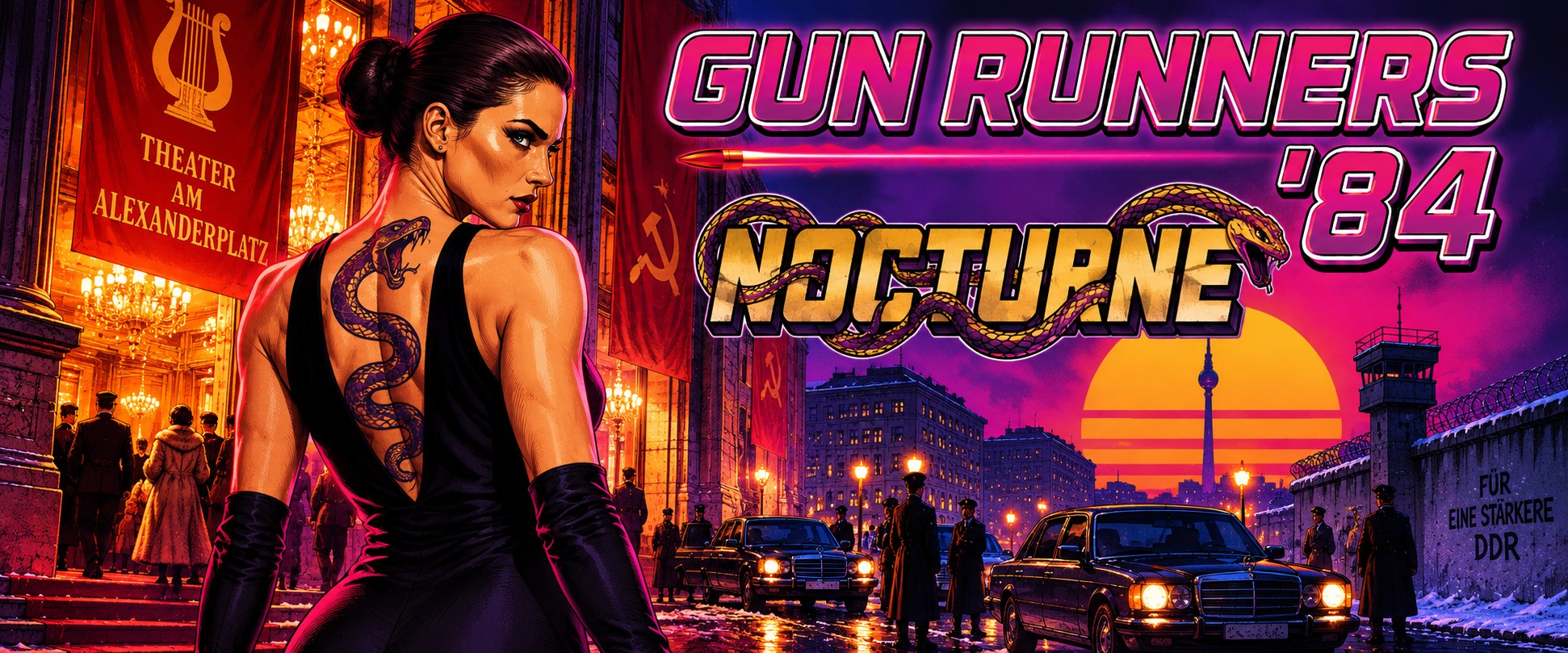
Every world in Gun Runners '84 has someone like Selena Nocturne working in it. Eleven years after leaving the East Berlin stage, she comes back to the same theater for one night only—not to dance, but to make sure a Soviet general never leaves the building.
This free short story deepens the mainline: one gala, one general, East Berlin, January 1984. Read it below, free, no strings attached.
Snow had been falling over East Berlin since dusk, thin white flakes drifting through the orange wash of the streetlamps and gathering in dirty ridges along the curbs. The city seemed built to swallow color in winter. Concrete apartment blocks stood shoulder to shoulder beneath a black sky, their windows glowing weakly behind curtains while Trabants coughed through intersections and buses dragged themselves through the slush. Somewhere beyond the rooftops, searchlights moved slowly along the Wall.
A black Mercedes-Benz 280 SE rolled east through the snow.
Selena Nocturne sat alone in the rear seat, one leg crossed over the other, watching the city through the window as though she had never seen it before.
She wore black.
Not the practical black of policemen or soldiers, but something designed to be remembered. Beneath a dark wool evening coat, a midnight-black dress followed the narrow line of her body before falling almost to the floor. Long gloves covered her arms. Beneath the coat, one red heel occasionally caught the passing streetlights.
Her hair was pulled into a flawless bun.
Not one strand escaped it.
The driver glanced at her in the rear-view mirror. “Friedrichstrasse?”
“No,” Selena replied without looking at him. “The theater.”
The driver’s eyes returned immediately to the road. A few seconds later, recognition crept into his expression and he looked at her again, more carefully this time.
Selena noticed.
She noticed everything.
The driver swallowed. “Of course, Frau Nocturne.”
Selena said nothing.
The Mercedes continued through Alexanderplatz, passing beneath television-tower light and Soviet banners shifting in the wind. Eleven years had passed since Selena had traveled these roads with costumes hanging behind her and stage makeup still clinging to her eyes.
She had been twenty-three then.
Hungry enough to work fourteen-hour rehearsals for eight minutes beneath the lights. Disciplined enough to hide bruised feet inside perfect shoes. Beautiful enough for directors to notice, and intelligent enough to understand that being noticed was never the same as being valued.
East Berlin had taught her that.
So had the stage.
Never miss your mark.
Never break character.
Never allow the audience to see what anything costs.
Useful lessons.
Selena watched a searchlight sweep across the distant sky.
Applause meant nothing.
Survival meant everything.
The Mercedes turned onto a broader boulevard and the theater appeared ahead, blazing gold against the winter darkness.
The Theater am Alexanderplatz had been dressed for importance. Red banners hung from stone columns. Television lights illuminated the entrance. Black government Volgas, Mercedes saloons and polished Soviet ZILs crowded the curb while photographers huddled beneath the awning in heavy coats.
Tonight was officially a celebration of cultural cooperation between the German Democratic Republic and the Soviet Union.
Unofficially, half the audience would be watching the other half.
Diplomats.
Party officials.
Military officers.
Industrialists.
Intelligence men.
And one dead man who had not realized it yet.
“And one dead man who had not realized it yet.”
The Mercedes stopped beneath the awning.
The driver hurried around and opened Selena’s door.
She stepped into the snow.
One red heel.
Then the other.
The driver’s gaze lingered as Selena straightened her coat. She looked at him once and his eyes immediately moved elsewhere.
Better.
She crossed toward the entrance.
Every heel landed at precisely the same interval.
Not hurried.
Not slow.
Measured.
The rhythm had never left her.
Neither had the theater.
The smell reached her almost as soon as the doors opened.
Dust.
Paint.
Old velvet.
Warm electrical wiring.
Perfume.
People imagined theaters smelled glamorous.
They did not.
They smelled of labor.
A security officer stepped forward before Selena reached the main line. “Ihre Einladung, bitte.”
She handed him a heavy cream card.
The officer examined it beneath a brass lamp and then studied her face.
His posture changed.
“Frau Nocturne.”
Selena inclined her head slightly.
The officer handed the invitation back. “Welcome back.”
Selena took it between two gloved fingers. “I haven’t returned.”
The officer hesitated, unsure whether she had made a joke.
Selena walked past him.
The foyer was crowded with warm bodies and expensive clothes. Chandeliers cast gold across polished stone while champagne traveled through the room on silver trays. Women wore gowns beneath fur stoles. Men shook hands while measuring one another’s usefulness.
Selena moved between them like a blade through silk.
A conversation near the staircase faltered as she passed.
Then another.
Once, she had needed those glances.
Now they were merely information.
Who watched.
Who looked away.
Who whispered.
Who recognized her.
At the top of the staircase stood someone who did.
Otto Weiss had become old.
There was no kinder description.
His hair had retreated to a gray horseshoe around his skull. The broad shoulders Selena remembered had collapsed inward, and half-moon spectacles now rested on a nose that had always been permanently red from cheap schnapps. His tuxedo, however, remained immaculate.
Some things survived.
Otto stopped speaking in the middle of a conversation and stared down at her. “Selena?”
She stopped three steps below him. “Hello, Otto.”
“My God.” Otto laughed once in disbelief and descended toward her. “It really is you.”
Selena allowed him to take her gloved hand, although something in her expression prevented the embrace he had clearly been considering.
Otto looked her over. “You look exactly the same.”
“No one looks exactly the same,” Selena replied.
“You do.”
Selena held his gaze. “No.”
Otto smiled, then his eyes moved to her hair. “The bun.”
“Still.”
“I used to tell you to loosen it.”
“You used to tell everybody everything.”
Otto laughed, genuinely this time. “You haven’t changed.”
Selena looked beyond him toward the auditorium doors. “Yes, I have.”
The first bell sounded and the conversations around them began to shift as guests prepared to take their seats.
Otto followed Selena’s gaze. “I heard you were in Paris.”
“I was.”
“Rome?”
“Yes.”
“Vienna?”
“For a while.”
Otto seemed fascinated by every answer. “And now you’re back in Berlin?”
“Tonight.”
His eyes brightened. “For the performance?”
Selena looked at him. “Yes.”
“You’re performing?”
Her smile was faint. “Something like that.”
The second bell rang.
Otto glanced toward the auditorium. “Your old dressing room still exists, you know. They use it for storage now, but the mirror is still there. Even the bulbs, I think.”
“I know where it is.”
Otto stopped smiling for half a second.
Of course she did.
Selena touched his sleeve lightly. “Enjoy the show, Otto.”
Before he could answer, she disappeared into the flow of guests.
General Viktor Malenkov arrived seven minutes late.
Selena watched him from above.
She stood in darkness on an old lighting gantry thirty feet above the auditorium, her coat removed and her black dress absorbing what little light reached her.
Below, nearly nine hundred people filled the theater.
The orchestra tuned beneath the stage.
Malenkov entered through the central doors surrounded by four men.
Two bodyguards.
One East German security officer.
One aide.
Selena watched the formation change as they entered.
The aide looked nervous.
The security officer watched the room.
The first bodyguard watched people.
The second watched exits.
Competent.
Malenkov watched women.
Less competent.
He was sixty-one, heavy through the shoulders and stomach, with gray hair swept straight back from a broad face that newspapers probably described as distinguished. Tonight he wore a dark civilian suit rather than uniform.
Discretion.
Selena almost smiled.
Viktor Malenkov had spent almost three decades accumulating secrets across Afghanistan, Angola, Syria and East Germany. He sold some, buried others and used the remainder to make himself indispensable.
Three months earlier, he had sold one secret twice.
Once to Moscow.
Once to someone who paid considerably better.
That transaction had made several men very rich.
It had also made Malenkov inconvenient.
Selena had been paid to correct the inconvenience.
She did not care who had hired her.
She did not care what Malenkov knew.
She cared that the money had cleared.
And that Viktor Malenkov would not leave the theater alive.
Below, Malenkov reached his seat in the sixth row.
Selena checked the small watch beneath her glove.
19:57.
Three minutes.
She moved.
The gantry connected with a narrow steel staircase descending behind the scenery tower. Selena crossed it without a sound and reached the bottom just as the house lights began to dim.
A stagehand hurried past carrying a coil of electrical cable and almost collided with her. He stopped immediately. “You can’t be back here.”
Selena raised one finger gently to her lips.
The young man stared.
She stepped closer, allowing uncertainty to soften her face. “I’m sorry. I was looking for the company dressing rooms.”
“You’re on the wrong level,” he told her, visibly less interested in security now that she was standing close enough for him to smell her perfume.
Selena looked at his name badge. “Matthias?”
He smiled nervously. “Yes.”
“Your tie is crooked, Matthias.”
“What?”
Selena reached up and straightened it. “There.”
Matthias glanced down. “Thank you.”
“You’re welcome.”
Selena walked away.
Matthias watched her disappear around the corner.
He never noticed the dressing-room key had left his pocket.
The old corridor was smaller than Selena remembered.
Memory enlarged things.
Childhood homes.
First lovers.
Stages.
She walked beneath bare bulbs and peeling paint until she reached a green door marked 17.
Someone had painted over the number twice.
She could still see it.
Selena inserted Matthias’s key.
The lock clicked.
Inside were broken chairs, rolled scenery and boxes of programs dating back years. A costume rail occupied the far wall.
But the mirror remained.
Twelve bulbs surrounded it.
Only eight worked.
Selena closed the door behind her and crossed slowly toward the dressing table.
For several seconds she simply stood there.
Then she looked into the mirror.
Twenty-three years old.
She could almost see her younger self sitting in the chair, sweat cooling across her shoulders, hands shaking after a performance while Otto shouted compliments from the corridor.
Back then she had believed discipline meant enduring pain.
She understood it better now.
Discipline was deciding who felt it.
Selena removed her gloves.
A slim gold ring sat on her right hand. Decorative to anyone who did not know better. The stone concealed a reservoir smaller than a raindrop.
She placed a tiny dart on the dressing table.
Then a coil of wire.
Three instruments.
Three contingencies.
Selena opened the costume cupboard.
Exactly where she had been told it would be, a white garment bag hung among moth-eaten coats.
She unzipped it.
Inside waited tonight’s second costume.
The first man died at 20:19.
Selena never learned his name.
Dieter Kroll would appear in a report before midnight, but to her he was simply the additional security officer whose patrol crossed her route for seventeen seconds.
Seventeen seconds was enough.
Kroll rounded a corner beneath a red EXIT lamp and found a woman standing beside the scenery lift.
Selena now wore the costume prepared for the evening’s second act: black leotard, sheer skirt, stage shoes and the same immaculate bun.
Kroll stopped. “Who are you?”
Selena let fear into her posture. Shoulders slightly inward. Chin lowered. Eyes wider.
Fear was performance.
“I think I’m lost,” she said.
“You shouldn’t be here.”
“I know.”
Kroll approached. “The company rooms are on the other side.”
Selena took one uncertain step and deliberately lost her balance.
Kroll caught her by the arms. “Careful.”
“Thank you,” Selena whispered.
The dart entered beneath his jaw.
Kroll’s eyes widened.
Selena held him upright. “Don’t.”
His hand moved toward his throat.
“Don’t fight it,” she said softly.
His knees weakened.
Selena lowered him behind a stack of scenery rather than allowing him to fall. Kroll tried to speak, but nothing coherent emerged.
Selena watched.
Ten seconds.
Twelve.
Fourteen.
Stillness.
She removed the dart.
There was almost no blood.
From beyond the wall came applause.
Selena checked her reflection in a polished piece of scenery.
Perfect.
Her cue was approaching.
She stepped over Kroll and moved toward the stage.
The audience never knew she had not rehearsed.
That was the beautiful part.
Selena entered beneath white light with eleven other women.
For the first time in eleven years, Selena Nocturne performed in East Berlin.
Her body remembered before her mind needed to.
Step.
Turn.
Extend.
Hold.
Every movement returned from somewhere deeper than thought.
The audience disappeared.
The years disappeared.
There was only timing.
Music.
Distance.
Control.
She crossed behind another dancer, turned, and found Viktor Malenkov in the sixth row.
He was watching her.
Of course he was.
Selena held his gaze for less than a second before turning away.
Malenkov leaned toward his aide and said something.
The aide opened the program.
Selena continued moving.
Five.
Six.
Seven.
Turn.
She understood immediately.
The aide was checking the company list.
Her name was not there.
Eight.
Nine.
Extend.
Hold.
The orchestra resolved.
The audience applauded.
Selena smiled.
Malenkov smiled back.
The curtain fell.
Darkness swallowed the stage.
The performers exhaled around her. One woman laughed with relief while another reached for Selena’s arm.
“Who are you?” the dancer asked.
Selena walked past her.
Behind them, a man’s voice rose sharply.
The aide had discovered the discrepancy.
Right on time.
The second man died at 20:41.
He was better.
Selena realized that immediately.
Malenkov’s bodyguard did not shout when he discovered Kroll behind the scenery.
He crouched.
Checked the neck.
Saw the puncture.
Then reached beneath his jacket and drew a Makarov.
Good.
He moved into the corridor without calling for anyone.
Better.
He advanced alone.
Mistake.
Selena waited behind a half-open costume-room door.
The bodyguard passed.
The garrote slipped over his throat.
She pulled.
He reacted instantly, driving an elbow backward.
Selena rotated her hip and allowed the strike to glance away.
He was considerably stronger than she was.
Irrelevant.
Strength mattered only when force opposed force.
Selena did not allow that.
She stepped behind his knee and changed the angle of the wire.
The bodyguard tried to bring the Makarov around.
Selena trapped his wrist against her hip.
He drove her backward into the wall.
Pain flashed through her shoulder.
She tightened the wire.
He slammed her into the wall again.
Her teeth clicked together.
Again.
Selena’s face remained expressionless.
His movements weakened.
The pistol dropped.
His fingers clawed desperately at the wire.
Selena pulled until he sank to his knees, then followed him down without giving up the pressure.
The orchestra continued beyond the wall.
His face darkened.
His legs kicked once.
Twice.
Stopped.
Selena held the garrote for another ten seconds.
Certainty was worth ten seconds.
Then she released him.
A narrow red line circled his throat.
Selena recoiled the wire and returned it beneath her costume.
She picked up the Makarov and examined it.
Then placed it beside the dead man’s hand.
Guns were noisy.
“Guns were noisy. Guns were crude. Guns told everyone exactly when somebody had died. Selena preferred ambiguity.”
Guns were crude.
Guns told everyone exactly when somebody had died.
Selena preferred ambiguity.
She checked her watch.
20:44.
Sixteen minutes.
Viktor Malenkov liked champagne.
That information had cost somebody three thousand dollars.
Selena considered it money well spent.
During the interval, the theater transformed itself into a machine designed to put alcohol into important people. Doors opened, waiters appeared and officials migrated toward private reception rooms.
Malenkov’s remaining bodyguard stayed close to him.
The aide stayed closer.
Security had not yet found the second body.
Selena changed again.
Midnight-black dress.
Red heels.
Long gloves.
The transformation took four minutes.
When she entered the reception room, nobody questioned her presence.
That was another lesson the stage had taught her.
Costume was permission.
“Costume was permission. Dress as though you belonged somewhere and most people would invent the explanation for you.”
Dress as though you belonged somewhere and most people would invent the explanation for you.
Malenkov saw her immediately.
His eyes narrowed with recognition.
Then interest.
He said something quietly to his aide.
The aide crossed toward Selena. “Excuse me, madam. General Malenkov would like to know whether you are with the company.”
Selena selected a champagne glass from a passing tray. “Would he?”
The aide glanced back toward his employer. “Yes.”
Malenkov raised his own glass from across the room.
Selena smiled faintly. “No.”
The aide blinked. “No?”
“No.”
“Then may I ask—”
“No.”
Selena walked past him.
Malenkov laughed.
She stopped beside the general.
Up close, he smelled of expensive cologne and cigarettes.
“You caused a problem,” Malenkov said in German.
“Did I?”
“My assistant cannot find you in the program.”
Selena glanced toward the aide. “Perhaps your assistant should watch the performance instead of reading about it.”
Malenkov smiled. “You’re German?”
“Sometimes.”
“French?”
“When necessary.”
“Russian?”
Selena looked directly into his eyes. “Never.”
Malenkov laughed again.
His remaining bodyguard did not.
Selena noticed the man’s right hand beneath his jacket but gave him no attention.
Malenkov raised his glass. “Viktor.”
“I know.”
That interested him.
“And you are?”
“Selena.”
“Selena what?”
“Nocturne.”
He repeated the name as though tasting it. “Selena Nocturne.”
She allowed him the pleasure.
Malenkov studied her face. “Have we met?”
“No.”
“I would remember.”
“Yes.”
A tiny disturbance crossed Malenkov’s expression.
Selena enjoyed those.
He recovered quickly. “What brings you back to Berlin?”
“The same thing that brings everyone.”
“And what is that?”
Selena looked around the reception room at generals, diplomats, businessmen and intelligence officers pretending not to watch one another.
“Opportunity.”
Malenkov laughed.
A waiter approached with a tray of champagne.
Selena watched it.
Six glasses.
She took one.
Malenkov reached for another.
Selena stopped him with a quiet, “No.”
His hand paused.
She offered him hers instead. “This one.”
Malenkov looked at the glass.
Then at Selena.
His bodyguard immediately stepped closer. “General—”
Malenkov dismissed him with an irritated movement of one hand.
Male vanity.
The cheapest security weakness in the world.
He took Selena’s glass.
Their fingers touched.
The mechanism beneath her ring depressed.
Something smaller than a tear disappeared against the stem.
Malenkov raised the champagne. “To opportunity.”
Selena took another glass from the tray. “To endings.”
He drank.
So did she.
Viktor Malenkov did not collapse.
That would have been vulgar.
He finished the champagne.
He continued talking.
He introduced Selena to a deputy minister whose name she immediately discarded.
Five minutes passed.
Nothing.
Seven.
Malenkov touched his chest once.
Selena saw it.
Nobody else did.
Nine minutes.
A sheen of perspiration appeared at his hairline.
Malenkov loosened his collar. “Warm in here.”
“Is it?” Selena asked.
His aide looked across at him. “General?”
Malenkov waved the concern away. “Nothing.”
Selena watched his pupils.
Ten minutes.
The champagne glass slipped fractionally in Malenkov’s hand.
His bodyguard noticed.
“Sir?”
Malenkov inhaled.
The breath did not seem enough.
Confusion crossed his face first.
Then understanding.
His eyes found Selena.
She stood six feet away.
Perfectly still.
Malenkov stared at her.
Selena raised her glass.
His knees buckled.
The room erupted.
The bodyguard caught him before he hit the floor. Someone shouted for a doctor. Glass shattered. Guests moved backward while the aide screamed instructions.
Selena remained where she was.
Malenkov’s eyes stayed fixed on her.
He knew.
That mattered.
He tried to speak.
Nothing came.
Selena smiled.
Not warmth.
Performance.
Malenkov convulsed once in the bodyguard’s arms.
Then stopped.
A doctor forced his way through the crowd.
Selena turned away.
The performance was over.
The lockdown began less than two minutes later.

There was no alarm.
East Germans were subtler than that.
Doors simply closed.
Uniformed security officers appeared at every public exit while men in civilian clothes began speaking urgently into telephones. Guests were instructed to remain where they were until the general’s condition could be established.
Selena walked toward the auditorium.
A young security officer stepped into her path. “Madam, please return to the reception room.”
“I need the powder room.”
“You’ll have to wait.”
Selena studied him.
Twenty-five, perhaps.
Wedding ring.
Nervous eyes.
Not one of Malenkov’s people.
Not part of the contract.
She could kill him.
Instead she smiled. “Of course.”
The officer relaxed slightly.
Selena turned away.
Three steps later she passed through a side door.
By the time the young officer realized she had disappeared, Selena was already below the stage.
She moved quickly now, but never ran.
Running communicated guilt.
The theater’s hidden anatomy opened around her exactly as she remembered it: concrete stairwells, narrow service corridors, scenery workshops, rope systems, dressing rooms, storage cages and passages invisible to the audience sitting only feet away.
Eleven years vanished.
She knew where corridors should lead even when doors had changed.
She knew which staircases would terminate backstage and which would reach loading bays.
She knew old theaters always possessed routes forgotten by people who only worked in the front of the building.
Behind her came shouting.
They had found the bodyguard.
That accelerated matters.
Selena turned left toward the scenery tower.
Two security officers appeared at the far end.
“Stop!”
Selena did not.
One reached beneath his coat.
She kicked a stage brace loose as she passed.
A painted wall representing some eighteenth-century palace swung violently across the corridor.
The officers disappeared behind it with a crash.
Selena continued.
A hand caught her wrist at the next turn.
She pivoted instinctively.
Otto Weiss stood there.
His expression had changed completely.
“Selena.”
She looked at him.
Otto glanced toward the distant shouting. “What have you done?”
Selena said nothing.
Understanding spread across his face.
“My God.”
“Move, Otto.”
“You came here for him.”
“Move.”
His grip tightened slightly. “That man is dead.”
“Yes.”
“You killed him?”
Selena’s eyes settled on his hand around her wrist.
Otto released her immediately.
For several seconds neither moved.
Then Otto looked toward the corridor behind her. “They’ve locked every street entrance. The loading bay too.”
“I know.”
“You won’t get out.”
Selena almost smiled. “You always underestimated me.”
“I never underestimated you.”
“You tried to make me stay.”
“That wasn’t the same thing.”
“It was to me.”
Boots thundered somewhere nearby.
Otto’s eyes moved toward the sound.
Then he looked back at her. “Room seventeen.”
Selena said nothing.
“The old ventilation window is still there,” Otto continued. “The service stairs outside haven’t been used in years, but they still reach the alley.”
Selena studied him.
Otto’s voice softened. “You already knew.”
“Yes.”
He laughed once, without humor. “Of course you did.”
Selena stepped past him.
Otto turned after her. “Selena.”
She stopped.
He seemed to search for something worth saying.
Finally he asked, “Was any of it real?”
Selena looked back.
“The stage?”
Otto nodded.
Selena considered the question.
Then she gave him the only answer he was going to receive. “Every night.”
She disappeared down the corridor.
Room seventeen waited exactly where she had left it.
Selena unlocked the door.
Entered.
Closed it behind her.
For the first time that evening, she was completely alone.
The mirror bulbs hummed.
Eight alive.
Four dead.
The same arrangement as before.
Selena sat.
She removed her gloves and placed them carefully on the dressing table.
The poison ring followed.
Then the dart.
Then the garrote.
Three instruments arranged in a perfect line.
She looked at herself.
No smile now.
No fear.
No excitement.
Only Selena.
Beyond the walls, men shouted to one another.
Doors opened.
Closed.
Closer.
She raised both hands toward the back of her head.
The first pin came free.
Selena placed it on the dressing table.
Then the second.
The third.
The bun loosened.
Another pin.
Another.
Her dark hair slipped across her shoulders.
Selena watched it happen in the mirror.
For the briefest moment, twenty-three-year-old Selena looked back at her.
The woman who had once sat in this same chair after performances, listening to applause through the walls and waiting for Otto to tell her she had been magnificent.
She wondered what that woman would think of her now.
The thought lasted perhaps two seconds.
Then Selena stood.
The narrow service window remained behind the costume rack.
She pulled the rail aside and opened it.
Freezing air and snow blew into the dressing room.
Beyond the window, an iron maintenance staircase clung to the rear of the theater.
Boots were almost outside her door.
Selena put on her coat.
Her hair remained loose.
She climbed through the window.
The first security officer entered room seventeen less than thirty seconds later.
Otto arrived behind them.
The window stood open.
Snow scattered across the floor.
One officer searched the cupboards while another crossed to the dressing table.
Five hairpins lay beside the mirror.
Nothing else.
The officer picked one up. “Do you know whose room this was?”
Otto stared at the empty chair. “Yes.”
“Who?”
For a moment Otto remembered a young woman standing in the wings eleven years earlier, back perfectly straight despite bleeding feet.
Never late.
Never frightened.
Never missing a step.
“Selena.”
The officer waited. “Surname?”
“Nocturne.”
He wrote it down. “Where does she live?”
Otto almost laughed. “I have no idea.”
“When did you last see her?”
“Tonight.”
“Before tonight.”
“Eleven years ago.”
The officer frowned. “And she simply came back?”
Otto looked at the open window. “Apparently.”
“Why?”
From somewhere outside came the distant sound of a car engine starting.
Otto stared at the five pins.
“For the performance.”
The black Mercedes waited beneath a railway arch three streets from the theater.
Selena emerged from the snow and opened the rear door herself.
The driver turned.
For several seconds he did not recognize her.
The dress was the same.
The red heels were the same.
The face was the same.
But her hair now fell loose around her shoulders.
Then understanding arrived.
The driver hurried out and opened the door fully. “Frau Nocturne.”
Selena climbed inside.
The driver returned behind the wheel. “Where to?”
Selena looked through the rear window.
Blue lights were beginning to spread across Alexanderplatz.
“West.”
The driver hesitated. “The crossing?”
“Yes.”
He started the Mercedes.
They pulled away.
East Berlin moved past the windows in a procession of concrete, snow and sodium streetlights. Watchtowers rose beyond the buildings as the car carried Selena toward the Wall.
She removed the gold ring from her finger and examined it beneath the passing light.
Empty.
She slipped it into her purse.
The driver looked at her in the mirror.
This time he could not resist.
“Was the performance good?”
Selena met his eyes.
The driver immediately regretted asking.
She turned toward the window and watched the city slide past.
Behind her stood the theater where she had once learned how to become somebody else beneath the lights.
Tonight she finally understood what those years had been preparing her for.
Timing.
Costume.
Movement.
The smile.
The ability to stand in front of hundreds of people and show them precisely what she wanted them to see.
The Mercedes approached the checkpoint.
Selena’s reflection appeared faintly in the dark window, hair loose around her shoulders, expression calm.
The driver cleared his throat. “Frau Nocturne?”
Selena looked toward him.
He gestured nervously toward the theater disappearing behind them. “You didn’t answer.”
Selena’s smile returned.
Faint.
Calculated.
Perfect.
“The audience seemed pleased.”
The Mercedes carried her into the January night.
And behind them, the curtain fell.
Selena Nocturne walks straight back out of this story and into the wider Gun Runners '84 underworld. Gun Runners '84 is out now in paperback and on Kindle, worldwide.