GUN RUNNERS '84: NOCTURNE
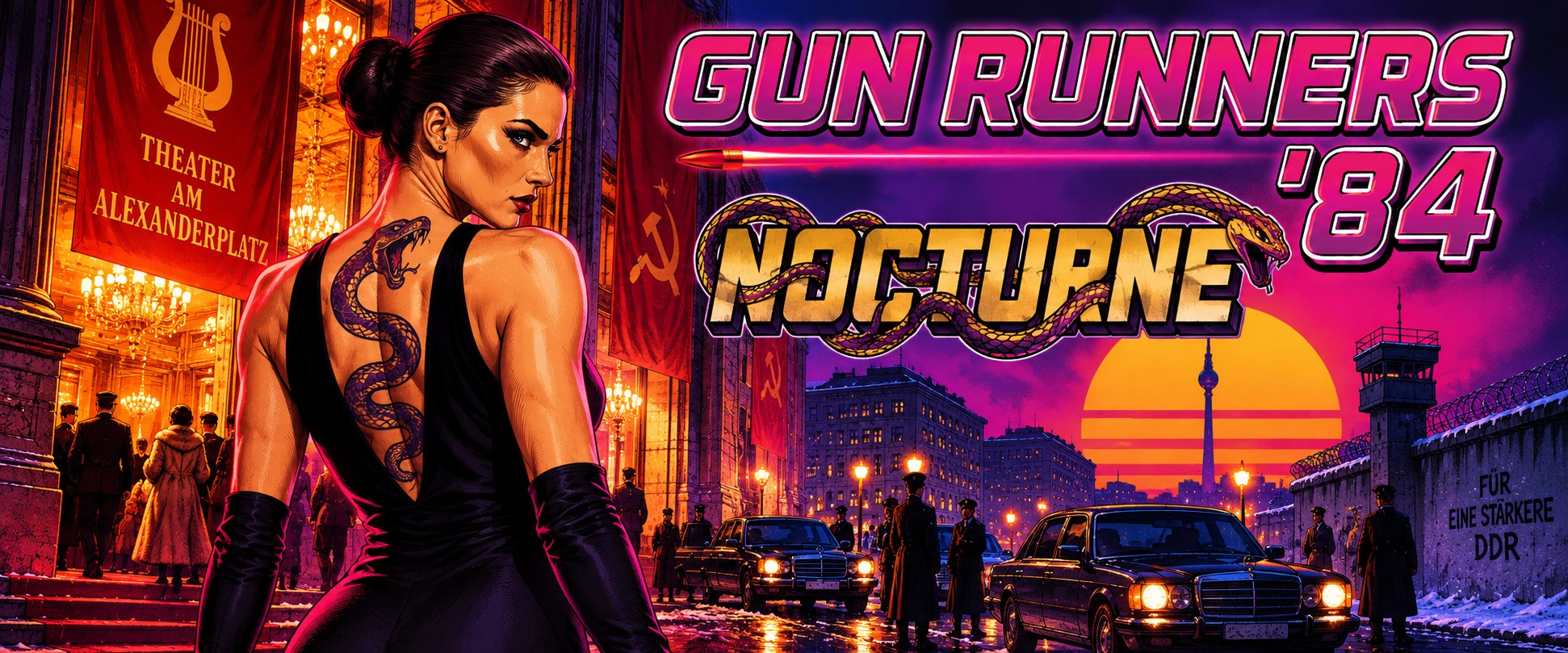
Every world in Gun Runners '84 has someone like Selena Nocturne working in it. Eleven years after leaving the East Berlin stage, she comes back to the same theater for one night only—not to dance, but to make sure a Soviet general never leaves the building.
This free short story deepens the mainline: one gala, one general, East Berlin, January 1984. Read it below, free, no strings attached.
Snow had been falling over East Berlin since dusk, thin white flakes drifting through the orange wash of the streetlamps and gathering in dirty ridges along the curbs. The city seemed built to swallow color in winter. Concrete apartment blocks stood shoulder to shoulder beneath a black sky, their windows glowing weakly behind curtains while Trabants coughed through intersections and buses dragged themselves through the slush. Somewhere beyond the rooftops, searchlights moved slowly along the Wall.
A black Mercedes-Benz 280 SE rolled east through the snow.
Selena Nocturne sat alone in the rear seat, one leg crossed over the other, watching the city through the window as though she had never seen it before.
She wore black.
Hers had nothing in common with the practical black of policemen or soldiers. It was designed to be remembered. Beneath a dark wool evening coat, a midnight-black dress followed the narrow line of her body before falling almost to the floor. Long gloves covered her arms. One red heel occasionally caught the passing streetlights.
Her hair was pulled into a flawless bun.
Not one strand escaped it.
The driver found her in the rear-view mirror. “Friedrichstrasse?”
Selena watched the snow. “No. The theater.”
He returned his attention to the road. A few seconds later, recognition crept into his expression and he checked the mirror again, more carefully this time.
Selena noticed.
She noticed everything.
The driver wet his lips. “The gala? I heard it was invitation only.”
“It is.”
He swallowed. “Of course, Frau Nocturne.”
The wipers dragged slush across the glass. At the next red light he cleared his throat.
“Forgive me. My mother took me to see you once. The spring of seventy-two. I was fourteen and I complained the whole tram ride there.”
“And the ride home?”
“I didn’t say a word. She’s never let me forget it.” He smiled into the mirror. “She still has the program.”
“Tell her to keep it somewhere dry.”
The light turned green. He drove on, pleased with himself, and did not try again.
The Mercedes continued through Alexanderplatz, passing beneath television-tower light and Soviet banners snapping in the wind. Eleven years had passed since Selena had traveled these roads with costumes hanging behind her and stage makeup still clinging to her eyes.
She had been twenty-three then.
Hungry enough to work fourteen-hour rehearsals for eight minutes beneath the lights. Disciplined enough to hide bruised feet inside perfect shoes. Beautiful enough for directors to notice, and intelligent enough to understand that being noticed was never the same as being valued.
East Berlin had taught her that.
So had the stage.
Never miss your mark.
Never break character.
Never allow the audience to see what anything costs.
Selena watched a searchlight sweep across the distant sky.
The Mercedes turned onto a broader boulevard and the theater appeared ahead, blazing gold against the winter darkness.
The Theater am Alexanderplatz had been dressed for importance. Red banners hung from stone columns. Television lights flooded the entrance. Black government Volgas, Mercedes saloons and polished Soviet ZILs crowded the curb while photographers huddled beneath the awning in heavy coats.
The driver whistled softly. “My dispatcher says half the Central Committee is in there tonight. And the Russians. More ZILs than a May Day parade.”
“Your dispatcher talks too much.”
“He does.” The driver laughed, then reconsidered the laugh and swallowed the rest of it.
Tonight was officially a celebration of cultural cooperation between the German Democratic Republic and the Soviet Union.
Unofficially, half the audience would be watching the other half.
Diplomats, Party officials, military officers, industrialists, intelligence men.
And one dead man who had not realized it yet.
“And one dead man who had not realized it yet.”
The Mercedes stopped beneath the awning.
The driver hurried around and opened Selena’s door. “I’ll be where you said, Frau Nocturne. Under the arch.”
“Don’t be early. Don’t be late.”
“Which is worse?”
“Early. A car sitting in the snow gets a policeman knocking on the glass.”
“And if you’re not out by eleven?”
“I will be.”
She stepped out.
One red heel.
Then the other.
The driver’s gaze lingered as Selena straightened her coat. She turned her face toward him once and he discovered something fascinating about the curb.
Better.
She crossed toward the entrance, every heel landing at precisely the same interval. Measured.
The rhythm had never left her.
Neither had the theater.
The doors opened and the old building breathed on her. Scorched dust off the lamps. Velvet nobody had cleaned since Ulbricht. A dozen French perfumes losing their war against fresh paint.
People imagined theaters smelled glamorous.
This one smelled of work. It always had.
A security officer stepped forward before Selena reached the main line. “Ihre Einladung, bitte.”
She handed him a heavy cream card.
The officer examined it beneath a brass lamp and then studied her face.
His posture changed.
“Frau Nocturne.”
Selena inclined her head slightly.
The officer handed the invitation back. “Welcome back.”
Selena took it between two gloved fingers. “I haven’t returned.”
He searched her face for the joke and couldn’t find one. “The doors to the stalls open at half past seven, madam.”
“I know when they open.”
Selena walked past him.
The foyer was crowded with warm bodies and expensive clothes. Chandeliers cast gold across polished stone while champagne traveled through the room on silver trays. Women wore gowns beneath fur stoles. Men shook hands while measuring one another’s usefulness.
Selena moved between them like a blade through silk.
A conversation near the staircase faltered as she passed.
Then another.
Fragments followed her across the stone.
“…the Nocturne girl, from the old company…”
“…thought she was in Paris…”
A woman in a silver fox stole caught her elbow at the foot of the stairs. “Fräulein Nocturne? Forgive me. My daughter started dancing because of you.”
“I’m sorry to hear it.”
The woman laughed, then realized Selena hadn’t, and let go of her arm.
Once, she had needed those whispers.
Now they were information.
At the top of the staircase stood someone who recognized her.
Otto Weiss had become old.
There was no kinder description.
His hair had retreated to a gray horseshoe around his skull. The broad shoulders Selena remembered had collapsed inward, and half-moon spectacles now rested on a nose that had always been permanently red from cheap schnapps. His tuxedo, however, remained immaculate.
Otto stopped speaking in the middle of a conversation and stared down at her. “Selena?”
She stopped three steps below him. “Hello, Otto.”
“My God.” Otto laughed once in disbelief and descended toward her. “It really is you.”
Selena allowed him to take her gloved hand, although something in her expression killed the embrace he had clearly been considering.
Otto took her in from heels to hair. “You look exactly the same.”
“No one looks exactly the same.”
“You do.”
Selena withdrew her hand. “No.”
Otto smiled, then his eyes went to her hair. “The bun.”
“Still.”
“I used to tell you to loosen it.”
“You used to tell everybody everything.”
Otto laughed, genuinely this time. “You haven’t changed.”
Her attention had already moved past him to the auditorium doors. “Yes, I have.”
“Well, the theater hasn’t. Do you know what they’ve given us tonight?” Otto leaned closer, the schnapps on his breath older than the champagne. “Folk dancers from Minsk. A children’s choir. A speech about steel production. And then our girls, dancing for an audience that will spend the whole time counting one another’s medals.”
“Who has the most?”
“Some Soviet general. Malenkov. They moved the curtain back fifteen minutes for him last week, and I promise you he’ll still be late.”
“Generals usually are.”
“You left without a word, you know. Not even a note on the company board.”
“A note would have been a scene. You’d have made it a scene.”
“I would have made it a tragedy in three acts.” Otto pressed a hand to his heart. “With an interval, so I could get drunk.”
“You were already drunk.”
“Details.”
The first bell sounded and the conversations around them began to shift as guests prepared to take their seats.
Otto lowered his voice. “I heard you were in Paris.”
“I was.”
“Rome?”
“Yes.”
“Vienna?”
“For a while.”
Otto seemed fascinated by every answer. “And now you’re back in Berlin?”
“Tonight.”
His eyes brightened. “For the performance?”
“Yes.”
“You’re performing?”
Her smile was faint. “Something like that.”
The second bell rang.
Otto turned toward the auditorium. “Your old dressing room still exists, you know. They use it for storage now, but the mirror is still there. Even the bulbs, I think.”
“I know where it is.”
Otto stopped smiling for half a second.
Of course she did.
Selena touched his sleeve lightly. “Enjoy the show, Otto.”
Otto caught her fingers. “Find me at the interval. We’ll drink to the old days and lie about how good they were.”
“If I can.”
He opened his mouth to argue, but she had already disappeared into the flow of guests.
General Viktor Malenkov arrived seven minutes late.
Selena watched him from above.
She stood in darkness on an old lighting gantry thirty feet above the auditorium, her coat removed and her black dress absorbing what little light reached her.
Below, nearly nine hundred people filled the theater.
The orchestra tuned beneath the stage.
Malenkov entered through the central doors surrounded by four men.
Two bodyguards.
One East German security officer.
One aide.
Selena studied the formation as it moved down the aisle.
The aide was nervous.
The security officer watched the room.
The first bodyguard watched people.
The second watched exits.
Competent.
Malenkov watched women.
Less competent.
He was sixty-one, heavy through the shoulders and stomach, with gray hair swept straight back from a broad face that newspapers probably described as distinguished. Tonight he wore a dark civilian suit rather than uniform.
Discretion.
Selena almost smiled.
Viktor Malenkov had spent almost three decades accumulating secrets across Afghanistan, Angola, Syria and East Germany. He sold some, buried others and used the remainder to make himself indispensable.
Three months earlier, he had sold one secret twice.
Once to Moscow.
Once to someone who paid considerably better.
That transaction had made several men very rich.
It had also made Malenkov inconvenient.
Selena had been paid to correct the inconvenience.
She did not care who had hired her.
She did not care what Malenkov knew.
She cared that the money had cleared.
And that Viktor Malenkov would not leave the theater alive.
Below, Malenkov reached his seat in the sixth row.
Selena checked the small watch beneath her glove.
19:57.
Three minutes.
She moved.
The gantry connected with a narrow steel staircase descending behind the scenery tower. Selena crossed it without a sound and reached the bottom just as the house lights began to dim.
A stagehand hurried past carrying a coil of electrical cable and almost collided with her. He stopped short. “You can’t be back here.”
Selena raised one finger gently to her lips.
The young man stared.
She stepped closer, allowing uncertainty to soften her face. “I’m sorry. I was looking for the company dressing rooms.”
“You’re on the wrong level.” He sounded a great deal less interested in security now that she was close enough for him to smell her perfume.
Selena read his name badge. “Matthias?”
He smiled nervously. “Yes.”
“Your tie is crooked, Matthias.”
“What?”
Selena reached up and straightened it. “There.”
His chin dipped to inspect her work. “Thank you. My supervisor says I dress like an unmade bed.”
“Your supervisor is right.”
He grinned. “The company rooms are one floor down, past the paint shop. Mind the third step. It’s been loose since before I started here.”
“It was loose before you were born.”
He laughed without knowing why. “You’ve worked here?”
“Once.”
Selena walked away.
Matthias watched her disappear around the corner, still touching his tie.
He never noticed the dressing-room key had left his pocket.
The old corridor was smaller than Selena remembered.
Memory enlarged things.
She walked beneath bare bulbs and peeling paint until she reached a green door marked 17.
Someone had painted over the number twice.
She could still see it.
Selena inserted Matthias’s key.
The lock clicked.
Inside were broken chairs, rolled scenery and boxes of programs dating back years. A costume rail occupied the far wall.
But the mirror remained.
Twelve bulbs surrounded it.
Only eight worked.
Selena closed the door behind her and crossed slowly toward the dressing table.
For several seconds she simply stood there.
Then she raised her eyes to the mirror.
Twenty-three years old.
She could almost see her younger self sitting in the chair, sweat cooling across her shoulders, hands shaking after a performance while Otto shouted compliments from the corridor.
Back then she had believed discipline meant enduring pain.
She understood it better now.
Discipline was deciding who felt it.
Selena removed her gloves.
A slim gold ring sat on her right hand. Decorative to anyone who did not know better. The stone concealed a reservoir smaller than a raindrop.
She placed a tiny dart on the dressing table.
Then a coil of wire.
Three instruments.
Three contingencies.
Selena opened the costume cupboard.
Exactly where she had been told it would be, a white garment bag hung among moth-eaten coats.
She unzipped it.
Inside waited tonight’s second costume.
The first man died at 20:19.
Selena never learned his name.
Dieter Kroll would appear in a report before midnight, but to her he was simply the additional security officer whose patrol crossed her route for seventeen seconds.
Seventeen seconds was enough.
Kroll rounded a corner beneath a red EXIT lamp and found a woman standing beside the scenery lift.
Selena now wore the costume prepared for the evening’s second act: black leotard, sheer skirt, stage shoes and the same immaculate bun.
Kroll stopped. “Who are you?”
Selena let fear into her posture. Shoulders slightly inward. Chin lowered. Eyes wider.
Fear was performance.
“I think I’m lost,” she said.
“You shouldn’t be here.”
“I know. They told me left at the lift, and then the lift was on the right, and now I don’t know which way the stage is.”
Kroll held out a gloved hand. “Pass.”
“In my bag. In the dressing room I can’t find.”
“Which company?”
“The second act. I’m on in ten minutes.”
Kroll sighed. “Every night it’s one of you girls wandering around back here like a lost goat. The company rooms are on the other side.”
Selena took one uncertain step and deliberately lost her balance.
Kroll caught her by the arms. “Careful.”
“Thank you,” Selena whispered.
The dart entered beneath his jaw.
Kroll’s eyes widened.
Selena held him upright. “Don’t.”
His hand moved toward his throat.
“Don’t fight it,” she said softly.
His knees weakened.
Selena lowered him behind a stack of scenery rather than allowing him to fall. Kroll tried to speak, but nothing coherent emerged.
Selena watched.
Ten seconds.
Twelve.
Fourteen.
Stillness.
She removed the dart.
There was almost no blood.
From beyond the wall came applause.
Selena checked her reflection in a polished piece of scenery.
Perfect.
Her cue was approaching.
She stepped over Kroll and moved toward the stage.
In the wings, a stage manager in a brown cardigan ran his pencil down a clipboard and stopped at her. “You. Who are you?”
“Brigitte’s cover.”
“Where’s Brigitte?”
“Being sick in the second-floor toilets. She sent me down.”
“Christ, tonight of all nights.” He scrubbed a hand over his face. “Do you know the piece?”
“Better than she does.”
“Fourth from the left. And don’t fall over in front of the Russians.”
“I never fall over.”
“Everybody falls over, Fräulein. Go.”
The audience never knew she had not rehearsed.
That was the beautiful part.
Selena entered beneath white light with eleven other women.
For the first time in eleven years, Selena Nocturne performed in East Berlin.
Her body remembered before her mind needed to.
Step.
Turn.
Extend.
Hold.
Every movement returned from somewhere deeper than thought.
The audience disappeared.
The years disappeared.
There was only timing.
Music.
Distance.
Control.
She crossed behind another dancer, turned, and found Viktor Malenkov in the sixth row.
He was watching her.
Of course he was.
Selena met his eyes for less than a second before turning away.
Malenkov leaned toward his aide and said something.
The aide opened the program.
Selena continued moving.
Five.
Six.
Seven.
Turn.
She understood immediately.
The aide was checking the company list.
Her name was not there.
Eight.
Nine.
Extend.
Hold.
The orchestra resolved.
The audience applauded.
Selena smiled.
Malenkov smiled back.
The curtain fell.
Darkness swallowed the stage.
The performers exhaled around her. One woman laughed with relief while another reached for Selena’s arm.
“Who are you?” the dancer asked.
The girl beside her was already craning toward the wings. “Where’s Brigitte? Is she all right?”
Selena walked past them both.
The stage manager’s voice chased her into the dark. “You! Fourth from the left! Get back here!”
Behind them, a man’s voice rose sharply in heavily accented German. “She is not on the list. The fourth girl. Where is the stage manager?”
The aide had discovered the discrepancy.
Right on time.
The second man died at 20:41.
He was better.
Malenkov’s bodyguard did not shout when he discovered Kroll behind the scenery.
He crouched.
Checked the neck.
Saw the puncture.
Then reached beneath his jacket and drew a Makarov.
Good.
He moved into the corridor without calling for anyone.
Better.
He advanced alone.
Mistake.
Selena waited behind a half-open costume-room door.
The bodyguard passed.
The garrote slipped over his throat.
She pulled.
He reacted instantly, driving an elbow backward.
Selena rotated her hip and allowed the strike to glance away.
He was considerably stronger than she was.
Irrelevant.
Strength mattered only when force opposed force.
Selena did not allow that.
She stepped behind his knee and changed the angle of the wire.
The bodyguard tried to bring the Makarov around.
Selena trapped his wrist against her hip.
He drove her backward into the wall.
Pain flashed through her shoulder.
She tightened the wire.
He slammed her into the wall again.
Her teeth clicked together.
Again.
Selena’s face showed nothing at all.
“Shh,” she breathed against his ear. “Listen to the orchestra.”
His movements weakened.
The Makarov hit the floor.
His fingers clawed desperately at the wire.
Selena pulled until he sank to his knees, then followed him down without giving up the pressure.
The orchestra continued beyond the wall.
His face darkened.
His legs kicked once.
Twice.
Stopped.
Selena held the garrote for another ten seconds.
Certainty was worth ten seconds.
Then she released him.
A narrow red line circled his throat.
Selena recoiled the wire and returned it beneath her costume.
She picked up the Makarov and weighed it in her palm.
Then placed it beside the dead man’s hand.
Guns were noisy.
“Guns were noisy. Guns were crude. Guns told everyone exactly when somebody had died. Selena preferred ambiguity.”
Guns were crude.
Guns told everyone exactly when somebody had died.
Selena preferred ambiguity.
She checked her watch.
20:44.
Sixteen minutes.
Viktor Malenkov liked champagne.
That information had cost somebody three thousand dollars.
During the interval, the theater transformed itself into a machine designed to put alcohol into important people. Doors opened, waiters appeared and officials migrated toward private reception rooms.
Malenkov’s remaining bodyguard stayed close to him.
The aide stayed closer.
Security had not yet found the second body.
Selena changed again.
Midnight-black dress.
Red heels.
Long gloves.
The transformation took four minutes.
When she entered the reception room, nobody questioned her presence.
Costume was permission.
“Costume was permission. Dress as though you belonged somewhere and most people would invent the explanation for you.”
Dress as though you belonged somewhere and most people would invent the explanation for you.
Malenkov saw her immediately.
His eyes narrowed with recognition.
Then interest.
He said something quietly to his aide.
The aide crossed toward Selena, straightening his jacket as he came. “Excuse me, madam. General Malenkov would like to know whether you are with the company.”
Selena selected a champagne glass from a passing tray. “Would he?”
The aide checked with his employer across the room. “Yes.”
Malenkov raised his own glass.
Selena smiled faintly. “No.”
The aide’s mouth opened and shut. “No?”
“No.”
“Then may I ask—”
“No.”
Selena walked past him.
Malenkov laughed.
She stopped beside the general.
Up close, he smelled of expensive cologne and cigarettes.
“You caused a problem,” Malenkov said in German.
“Did I?”
“My assistant cannot find you in the program.”
Selena tipped her glass toward the aide. “Perhaps your assistant should watch the performance instead of reading about it.”
Malenkov smiled. “You dance very well for someone who does not exist.”
“I dance very well for someone who skipped rehearsal.”
“You’re German?”
“Sometimes.”
“French?”
“When necessary.”
“Russian?”
Selena stared directly into his eyes. “Never.”
Malenkov laughed again.
His remaining bodyguard did not.
Selena noted the man’s right hand beneath his jacket and gave him no further attention.
Malenkov raised his glass. “Viktor.”
“I know.”
That interested him.
“And you are?”
“Selena.”
“Selena what?”
“Nocturne.”
He repeated the name as though tasting it. “Selena Nocturne.”
She allowed him the pleasure.
Malenkov studied her face. “Have we met?”
“No.”
“I would remember.”
“Yes.”
A tiny disturbance crossed Malenkov’s expression.
Selena enjoyed those.
He recovered quickly. “What brings you back to Berlin?”
“The same thing that brings everyone.”
“And what is that?”
Selena let her eyes travel the reception room, across generals, diplomats, businessmen and intelligence officers pretending not to watch one another.
“Opportunity.”
Malenkov laughed. “Then let us make an opportunity. When this nonsense is finished, you will have supper with me. The Ganymed, on the river. They keep a table for me.”
“I never make plans past the interval.”
“A superstition?”
“A rule.”
“I break rules for a living, Selena Nocturne.”
“So I’ve heard.”
The aide had found his courage again and edged back into the circle. “General, the stage manager says she was a replacement. He has no name for her on any list.”
“I have her name.” Malenkov never took his eyes off Selena. “Go and find me a cigarette.”
“Sir, security would like a word about—”
“Cigarette.”
A waiter approached with a tray of champagne.
Six glasses.
Selena took one.
Malenkov reached for another.
Selena stopped him with a quiet, “No.”
His hand paused.
She offered him hers instead. “This one.”
Malenkov studied the glass.
Then Selena.
His bodyguard immediately stepped closer. “General—”
Malenkov dismissed him with an irritated flick of one hand. “Pyotr thinks every woman in Berlin is trying to kill me.”
“Only the ones you’ve met,” Selena said.
That earned the loudest laugh yet.
He took Selena’s glass.
Their fingers touched.
The mechanism beneath her ring depressed.
Something smaller than a tear disappeared against the stem.
Malenkov raised the champagne. “To opportunity.”
Selena took another glass from the tray. “To endings.”
He drank.
So did she.
Viktor Malenkov did not collapse.
That would have been vulgar.
He finished the champagne.
He continued talking.
A soft man with a Party pin and a damp handshake drifted into their circle, and Malenkov clapped him on the back hard enough to spill his drink. “Selena, this is Klaus Hartung, Deputy Minister for Heavy Machinery. He builds tractors nobody can drive.”
The deputy minister gave a dutiful little laugh. “The general exaggerates, Fräulein. Our tractors are the envy of Poland.”
“Poland envies everything,” Malenkov said.
Selena discarded the man’s name as soon as she heard it.
Five minutes passed.
Nothing.
Malenkov was telling the deputy minister about Luanda. “March, Klaus. Forty degrees in the shade, and no shade. I lost eight kilos in a week.”
“You found them again,” Selena said.
“I always find what I lose.” He turned back to Selena. “Where did you learn to dance like that?”
“Here.”
“In this building?”
“Upstairs, mostly. The rehearsal rooms had better floors.”
“And you left all this for Paris.” Malenkov spread his free hand at the chandeliers. “Madness.”
“That’s what they told me at the time.”
Seven minutes.
Malenkov touched his chest once.
Selena saw it.
Nobody else did.
Nine minutes.
A sheen of perspiration appeared at his hairline.
Malenkov loosened his collar. “Warm in here.”
“Is it?” Selena asked.
The aide was back with the cigarettes. “General?”
Malenkov waved the concern away. “Nothing. Angola was warm. This is a sauna with chandeliers.”
Selena watched his pupils.
Ten minutes.
The champagne glass slipped fractionally in Malenkov’s hand.
His bodyguard noticed.
“Sir?”
Malenkov inhaled.
The breath did not seem enough.
Confusion crossed his face first.
Then understanding.
His eyes found Selena.
She stood six feet away, her own glass resting lightly at her waist.
Malenkov stared at her.
Selena raised her glass.
His knees buckled.
The room erupted.
The bodyguard caught him before he hit the floor. Glass shattered. Guests stumbled backward.
“General! General, look at me!”
“Doctor! Is there a doctor here?”
“Give him air, for God’s sake!”
The aide’s voice cracked over all of it. “Nobody leaves this room! Close the doors! Nobody leaves!”
Selena remained where she was.
Malenkov’s eyes stayed fixed on her.
He knew.
That mattered.
He tried to speak.
Nothing came.
Selena gave him the smile she used to save for curtain calls.
Malenkov convulsed once in the bodyguard’s arms.
Then stopped.
A doctor forced his way through the crowd, knelt and pressed two fingers to the general’s throat. He stayed there far too long. “His heart. It must have been his heart.”
“Then do something!” the aide shouted.
“There is nothing left to do.”
Selena turned away.
The performance was over.
The lockdown began less than two minutes later.

There was no alarm.
East Germans were subtler than that.
Doors simply closed.
Uniformed security officers appeared at every public exit while men in civilian clothes began speaking urgently into telephones.
“…yes, Comrade Colonel, the Soviet general…”
“…every exit, I said every exit…”
Guests were instructed to remain where they were until somebody with authority understood what had happened.
Selena walked toward the auditorium.
A young security officer stepped into her path. “Madam, please return to the reception room.”
“I need the powder room.”
“You’ll have to wait.”
“I’ve been waiting since the interval.”
“I’m sorry, madam. Nobody moves until we know about the general.”
“How long?”
“Until they tell me, madam.”
“And who tells you?”
He swallowed. “Somebody with more stars than me.”
Selena studied him.
Twenty-five, perhaps.
Wedding ring.
Nervous eyes.
Not one of Malenkov’s people.
Not part of the contract.
She could kill him.
Instead she smiled. “Of course.”
The officer’s shoulders came down an inch. “Thank you, madam. I’m sure it won’t be long.”
Selena turned away.
Three steps later she passed through a side door.
By the time the young officer realized she had disappeared, Selena was already below the stage.
She moved quickly now, but never ran.
Running communicated guilt.
The theater’s hidden anatomy opened around her exactly as she remembered it. Concrete stairwells and service corridors, rope systems and storage cages, passages the audience never knew existed only feet beneath their seats.
Eleven years vanished.
She knew where every corridor led, even where the doors had changed.
Behind her came shouting.
“Here! He’s here, behind the costume room!”
They had found the bodyguard.
Selena turned left toward the scenery tower.
Two security officers appeared at the far end.
“Stop!”
“Halt! Hands where I can see them!”
Selena kept walking.
One reached beneath his coat.
She kicked a stage brace loose as she passed.
A painted wall representing some eighteenth-century palace swung violently across the corridor.
The officers disappeared behind it with a crash.
“Get it off me! My leg—”
“She went left! Left, damn it!”
Selena continued.
A hand caught her wrist at the next turn.
She pivoted on instinct.
Otto Weiss stood there.
His whole face had changed.
“Selena.” Otto turned toward the distant shouting. “What have you done?”
“You should be upstairs with the others, Otto.”
Understanding spread across his face.
“My God.”
“Move, Otto.”
“You came here for him.”
“Move.”
His grip tightened slightly. “That man is dead.”
“Yes.”
“You killed him?”
Selena’s eyes settled on his hand around her wrist.
Otto released her immediately.
For several seconds neither moved.
“Who paid you?”
“Does it matter?”
“It matters to me.”
“Then it’s lucky you’ll never know.”
“Upstairs you asked me who had the most medals. And I told you, like an old idiot.”
“I already knew, Otto. You only told me he’d be late.”
“Was he?”
“Seven minutes.”
Then Otto peered down the corridor behind her. “They’ve locked every street entrance. The loading bay too.”
“I know.”
“You won’t get out. They’ll shoot you, Selena.”
“They’ll have to find me first.” Selena almost smiled. “You always underestimated me.”
“I never underestimated you.”
“You tried to make me stay.”
“That wasn’t the same thing.”
“It was to me.”
Boots thundered somewhere nearby.
Otto’s eyes flicked toward the sound, then returned to her. “Room seventeen.”
Selena waited for the rest.
“The old ventilation window is still there,” Otto continued. “The service stairs outside haven’t been used in years, but they still reach the alley.”
Selena studied him.
Otto’s voice softened. “You already knew.”
“Yes.”
He laughed once, without humor. “Of course you did. I’m an old fool trying to give directions to the only girl who never once missed her mark.”
“You were kind to me, Otto.”
“I was loud at you. It isn’t the same.”
Selena stepped past him.
Otto turned after her. “Selena.”
She stopped.
He seemed to search for something worth saying.
Finally he asked, “Was any of it real?”
Selena turned. “The stage?”
“The stage. The company. Those years.”
Selena considered the question.
Then she gave him the only answer he was going to receive. “Every night.”
She disappeared down the corridor.
Room seventeen waited exactly where she had left it.
Selena unlocked the door.
Entered.
Closed it behind her.
For the first time that evening, she was completely alone.
The mirror bulbs hummed.
Eight alive.
Four dead.
The same arrangement as before.
Selena sat.
She removed her gloves and placed them carefully on the dressing table.
The poison ring followed.
Then the dart.
Then the garrote.
Three instruments arranged in a perfect line.
She studied herself in the glass.
There was no smile now, no fear, no excitement.
Only Selena.
Beyond the walls, men shouted to one another.
Doors opened.
Closed.
Closer.
She raised both hands toward the back of her head.
The first pin came free.
Selena placed it on the dressing table.
Then the second.
The third.
The bun loosened.
Another pin.
Another.
Her dark hair slipped across her shoulders.
Selena watched it happen in the mirror.
For the briefest moment, twenty-three-year-old Selena was there in the glass.
The woman who had once sat in this same chair after performances, listening to applause through the walls and waiting for Otto to tell her she had been magnificent.
She wondered what that woman would think of her now.
The thought lasted perhaps two seconds.
Then Selena stood.
The narrow service window remained behind the costume rack.
She pulled the rail aside and opened it.
Freezing air and snow blew into the dressing room.
Beyond the window, an iron maintenance staircase clung to the rear of the theater.
Boots were almost outside her door.
“Seventeen! Try seventeen!”
Selena put on her coat.
Her hair remained loose.
She climbed through the window.
The first security officer entered room seventeen less than thirty seconds later.
Otto arrived behind them.
The window stood open.
Snow scattered across the floor.
One officer was already at the sill. “The window! She’s gone down the back stairs.”
The man behind him bellowed into the corridor. “Get men into the alley. Now!”
A third officer searched the cupboards while another crossed to the dressing table.
Five hairpins lay beside the mirror.
Nothing else.
The officer picked one up. “Do you know whose room this was?”
Otto stared at the empty chair. “Yes. Once.”
“Who?”
For a moment Otto remembered a young woman standing in the wings eleven years earlier, back perfectly straight despite bleeding feet.
Never late.
Never frightened.
Never missing a step.
“Selena.”
The officer waited. “Surname?”
“Nocturne.”
He wrote it down. “Where does she live?”
Otto almost laughed. “I have no idea.”
“When did you last see her?”
“Tonight.”
“Did she say anything to you tonight?”
“She told me to enjoy the show.”
The pencil stopped. “And before that?”
“Eleven years ago.”
“What did she do here?”
“She danced.”
He wet the tip of the pencil. “Was she any good?”
Otto took off his spectacles and rubbed his eyes. “She was the best I ever saw.”
The officer frowned. “And she simply came back?”
Otto turned to the open window. “Apparently.”
“Why?”
From somewhere outside came the distant sound of a car engine starting.
Otto stared at the five pins.
“For the performance.”
The black Mercedes waited beneath a railway arch three streets from the theater.
Selena emerged from the snow and opened the rear door herself.
The driver twisted around in his seat.
For several seconds he did not recognize her.
The dress was the same.
The red heels were the same.
The face was the same.
But her hair now fell loose around her shoulders.
Then understanding arrived.
The driver hurried out and opened the door fully. “Frau Nocturne.”
Selena climbed inside.
The driver returned behind the wheel. “Where to?”
Through the rear window, blue lights were beginning to spread across Alexanderplatz.
“West.”
The driver hesitated. “The crossing?”
“Yes.”
He started the Mercedes.
They pulled away.
“There’s police everywhere back there,” he ventured after a block.
“I saw.”
“Something happened at the gala?”
“A man was taken ill.”
“Anybody important?”
“He thought so.”
The driver chewed on that for half a block. “They’ll be slow at the crossing tonight.”
“Then we’ll be patient.”
“My wife says I’m never patient.”
“Your wife isn’t in the car.”
East Berlin moved past the windows in a procession of concrete, snow and sodium streetlights. Watchtowers rose beyond the buildings as the car carried Selena toward the Wall.
She removed the gold ring from her finger and examined it beneath the passing light.
Empty.
She slipped it into her purse.
The driver caught her eye in the mirror.
This time he could not resist.
“Was the performance good?”
Selena met his eyes.
The driver immediately regretted asking.
She turned toward the window and watched the city slide past.
Behind her stood the theater where she had once learned how to become somebody else beneath the lights.
Tonight she finally understood what those years had been preparing her for.
Timing.
Costume.
Movement.
The smile.
The ability to stand in front of hundreds of people and show them precisely what she wanted them to see.
The Mercedes approached the checkpoint.
Selena’s reflection appeared faintly in the dark window, hair loose around her shoulders, expression calm.
The driver cleared his throat. “Frau Nocturne?”
Selena turned from the glass.
He gestured nervously toward the theater disappearing behind them. “You didn’t answer.”
Selena’s smile returned.
Faint.
Calculated.
Perfect.
“The audience seemed pleased.”
The Mercedes carried her into the January night.
And behind them, the curtain fell.
Selena Nocturne walks straight back out of this story and into the wider Gun Runners '84 underworld. Gun Runners '84 is out now in paperback, hardback, and on Kindle, worldwide.