BILLY BOB
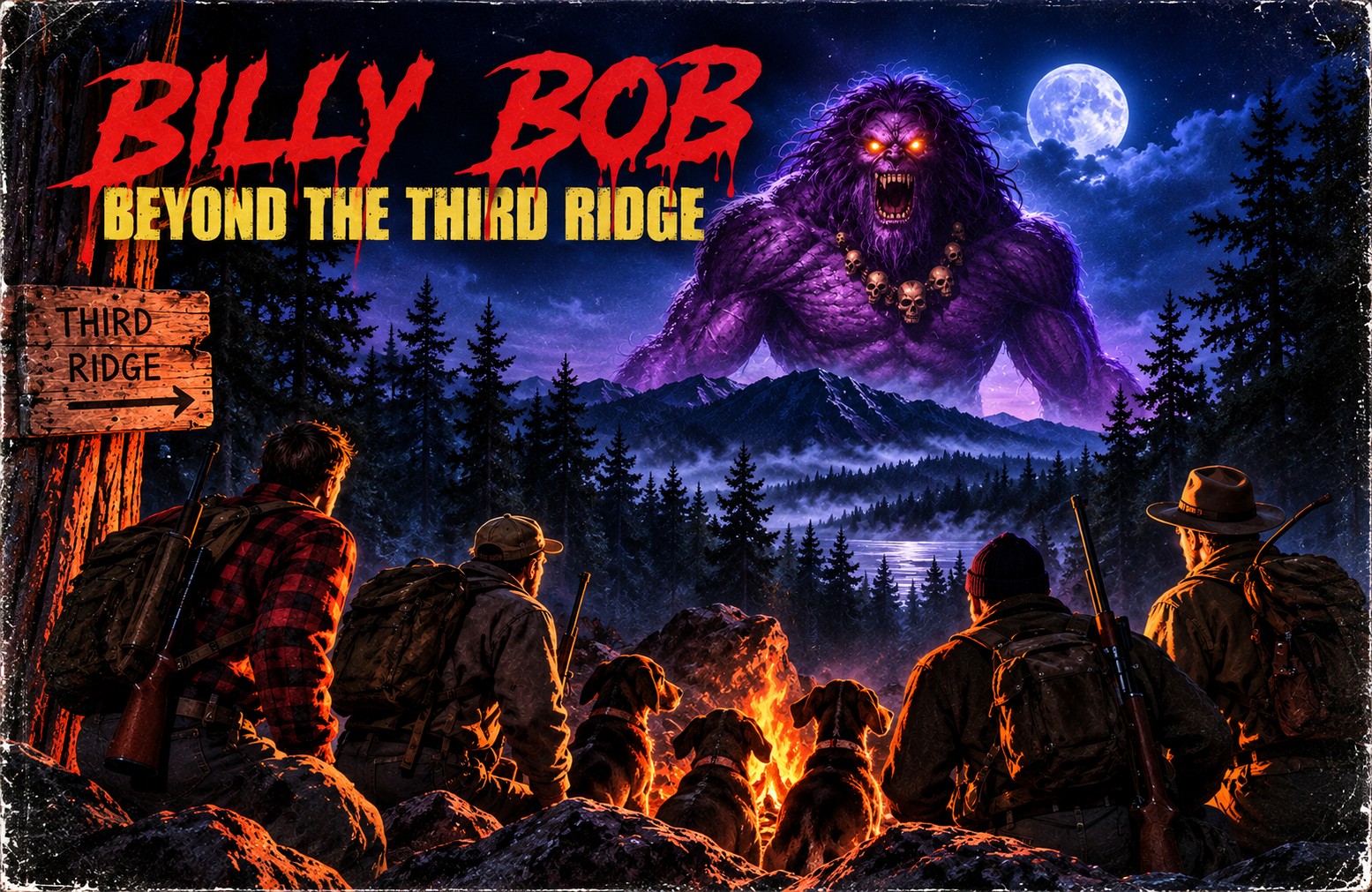
Every town near the mountains has a name grandparents stop saying once the grandkids are old enough to go looking for it. In the world of Billy Bob: The Purple Giant, that name is Billy Bob—and long before the valley started calling it Obsidian Hollow, families up and down that mountain already knew better than to ask why.
This free short story sits outside the novel entirely—a campfire tale passed from a grandfather to two children who’ve just heard the name for the first time. Read it below, free, no strings attached.
The fire had burned low enough that Grandpa should have put another log on it twenty minutes ago. He hadn’t. The old man sat deep in his chair with one hand resting on the worn leather arm, watching orange flame curl slowly around the blackened remains of the last piece of oak. Every few seconds something shifted inside the fireplace and sent a tiny shower of sparks climbing toward the chimney. Outside, rain touched the windows.
Not hard. Just enough to hear. The television had been switched off after dinner. Their mother was upstairs somewhere, talking on the telephone, and the house had settled into that peculiar evening quiet that made every pipe and floorboard seem louder than it really was. The two children sat on the rug in front of Grandpa’s chair. “Grandpa?”
He looked down. “Hmm?”
“Who’s Billy Bob?”
Something changed in the old man’s face. It was small enough that either child might have missed it if they hadn’t been looking directly at him. His eyes moved from them to the window. Rain slid down the glass, distorting the darkness outside. “Where’d you hear that name?”
“Dad said it.”
“When?”
“When we were driving here. We could see the mountains and he said that was where Billy Bob lived.”
Grandpa looked toward the staircase. “He shouldn’t have said that.”
The younger child grinned. “Is he a monster?”
“No.”
The answer came too quickly. The grin disappeared. Grandpa leaned forward and picked up the iron poker. He pushed the dying log deeper into the embers until flame climbed briefly along one edge. “He’s just a story.”
“Dad said you saw him.”
The poker stopped. For several seconds there was only the faint ticking of rain against the windows. Then Grandpa set the poker down. “No,” he said. “Your dad never said that.”
“He said you went into Billy Bob’s Hollow and never went back.”
The old man looked at them again. The younger child shifted closer to the fire. “Did you?”
Grandpa rubbed one hand slowly across his jaw. The skin there had loosened with age. Liver spots crossed the back of his hand. The children knew him as an old man who complained about the television being too loud and kept peppermints in the glove compartment. Neither of them had ever imagined him being afraid of anything. “Wasn’t called Obsidian Hollow then,” he said.
“What was it called?”
“Nothing. Wasn’t called Billy Bob’s Hollow either.”
“Everything has a name.”
“Not everything.”
He looked toward the window again. “There are places that don’t need one.”
The fire cracked. Both children jumped. Grandpa didn’t. He settled deeper into the chair. “This was a long time ago.”
“How long?”
“Long enough.”
“Were you a kid?”
“No.”
“Were you old?”
Grandpa almost smiled. “No.”
The rain strengthened slightly. He watched the flames for another moment. Then he began.
The four dogs knew before any of us did. That’s the part people always get wrong when they tell it. They say the woods went quiet first. They didn’t.
“The four dogs knew before any of us did. That’s the part people always get wrong when they tell it. They say the woods went quiet first. They didn’t.”
They say we heard something moving through the trees. We didn’t. They say one of us saw a giant standing on the ridge. Nobody saw anything.
Not then. The dogs knew. We’d been hunting that mountain every October for fifteen years. Same four men. Same stretch of forest. Same camp beyond the third ridge. My brother Ray and I started going when we were young enough to believe four days sleeping on frozen ground counted as a vacation. Frank Delaney came the second year. Charlie Webb the year after that.
After a while it became something you didn’t question. October came. We went hunting. That was it.
We knew every trail worth knowing. We knew where the deer crossed after rain. We knew where water gathered between the rocks when the creek ran low. We knew which slope caught morning sun first and where frost stayed until noon. And we knew about the big man. Everybody did. Nobody called him Billy Bob’s anything back then.
He was just Billy Bob. You’d see him in town sometimes. Not often. Maybe once a month.
He’d come out of the north road on foot and walk all the way to Mercer’s Feed and Grain. Biggest son of a bitch I ever saw in my life, and I knew some big men. Billy wasn’t tall the way tall people are tall. He was wide. Thick.
His shoulders looked like somebody had built them to carry something no other man could. He’d buy flour. Salt. Kerosene.
Sometimes matches. Never much else. Paid cash. Didn’t talk unless he had to.
Mercer used to say Billy could stand in that store ten minutes without saying a word and make everybody else whisper. People laughed about him when he wasn’t there. Nobody laughed when he was. Then he stopped coming.
One month. Two. Six. A year.
People stopped asking. Men disappear into mountains because they want to disappear. That was how people looked at it then. We certainly weren’t thinking about Billy Bob when we drove up that October. Why would we?
We had four days, enough food for six, two bottles of bourbon Frank’s wife didn’t know he’d packed, and four good dogs that knew those woods nearly as well as we did. The first night was cold. Nothing unusual. The second morning we moved north.
That was when the dogs changed. Ray noticed first. “Hold up.”
I turned. All four had stopped. Not sniffing. Not listening.
Stopped. Frank whistled. Nothing. His dog, Molly, looked at him and lowered herself onto the ground.
Then Duke went down. Then Sam. Then Red. Four dogs lying flat across the trail.
Charlie laughed. “What the hell’s wrong with them?”
Ray didn’t answer. He walked back and grabbed Duke by the collar. “Come on.”
Duke wouldn’t move. That dog weighed maybe seventy pounds. Ray pulled hard enough that the collar tightened around its neck. Duke flattened himself lower. Not tired.
Not stubborn. Afraid. I’d never seen a hunting dog do that. Frank crouched beside Molly and rubbed her neck.
She was shaking. I remember that more clearly than anything. Her whole body was trembling beneath his hand. There was no sound around us except the wind high in the trees.
No growling. No barking. Nothing. Charlie looked ahead.
The trail continued another fifty yards before disappearing between the pines. “What are they smelling?”
Nobody answered. Ray stood. He looked at me. “Third ridge.”
I knew. We’d crossed it maybe two hundred yards back. Frank tried Molly again. She made a sound.
Not a whine. Something lower. Almost like pain. “Leave them,” Charlie said. “They’ll follow.”
He started walking. Five steps. Ten. The dogs stayed exactly where they were.
Charlie turned around. “You coming?”
I don’t know why we followed him. Pride, probably. Most stupid things men do begin there. We left the dogs.
We went another quarter mile. And the forest changed. Not all at once. That’s another thing people tell wrong.
It didn’t become silent like somebody flipped a switch. It emptied. One sound at a time. Birds first.
Then insects. Then the little noises you never notice until they’re gone. By the time Ray stopped walking, I could hear Frank breathing behind me. Charlie looked back. “What?”
Ray lifted one hand. We listened. Nothing. Charlie gave a nervous laugh. “Great. Woods are quiet.”
Ray looked at him. “Woods aren’t quiet.”
Something moved behind us. All four of us turned. Nothing there. Just trees.
Frank raised his rifle. “Deer?”
“No.”
“How do you know?”
I didn’t answer. Because I did know. Whatever I’d heard had moved without panic. One step.
Maybe two. Then stopped when we stopped. Charlie started back toward the dogs. Nobody argued.
We found all four exactly where we’d left them. Except now they weren’t looking at us. They were staring past us. Back along the trail.
Molly’s lips had pulled away from her teeth. Still no growl. That frightened me more. “Camp,” Ray said.
It wasn’t a suggestion. We headed south. The dogs got up the moment we did. Not one of them looked back.
“Was that Billy Bob?” the younger child asked.
Grandpa looked down at him. “I haven’t finished.”
“But was it?”
His sister nudged him. “Shut up.”
“Don’t tell your brother to shut up.”
“Sorry.”
Grandpa looked at the fire. The last flame had almost disappeared. Neither child asked him to put another log on. He continued.
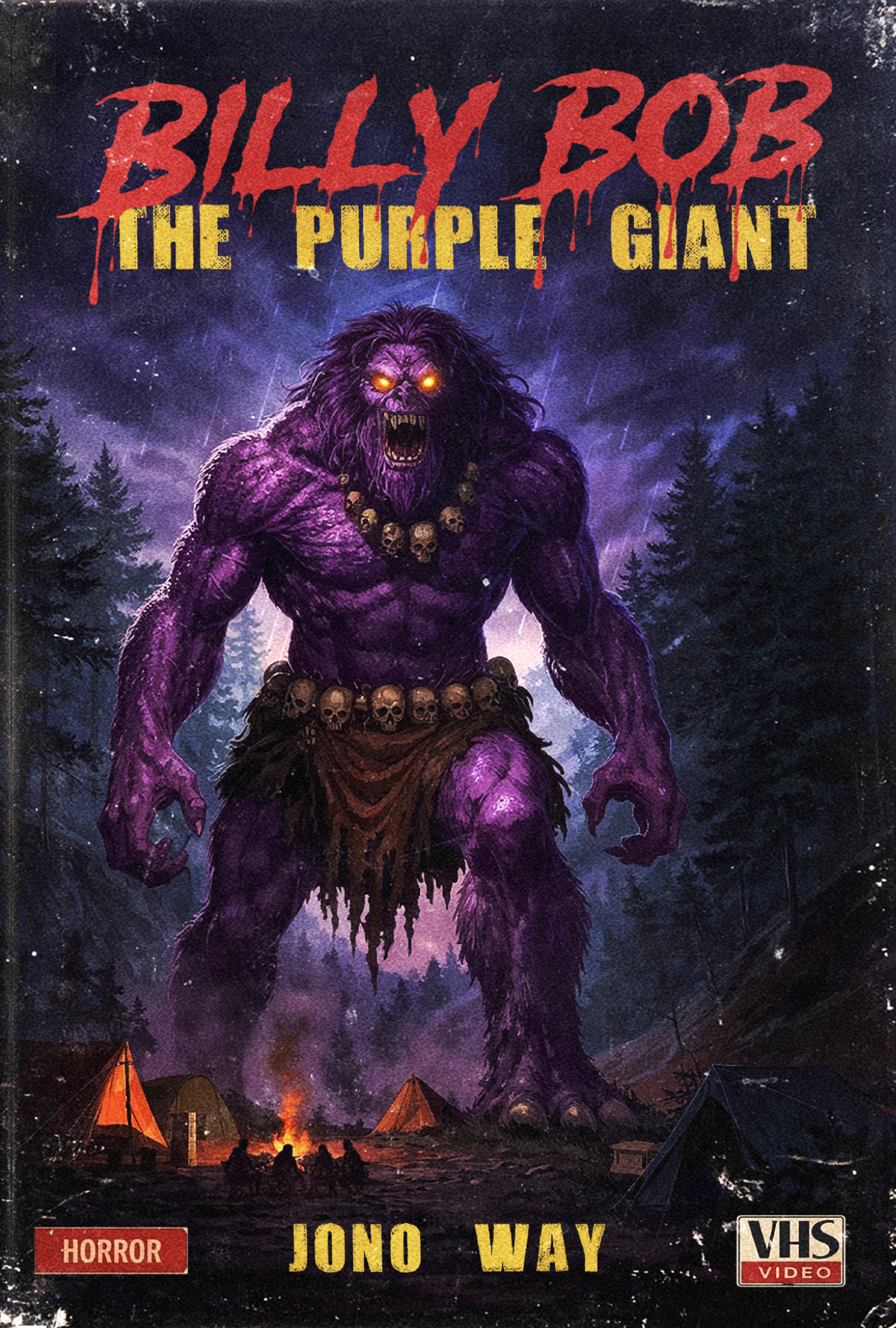
We should have left that afternoon. That’s what I’ve thought about for all these years. We should have packed everything, walked down the mountain and never looked back. But daylight makes fools of frightened men.
By four o’clock the birds were back. The dogs ate. Frank opened the bourbon. Charlie started making jokes about ghosts.
By six we had convinced ourselves nothing had happened. Almost. Ray hadn’t. He sat across the fire sharpening his knife long after the blade was sharp. “You remember Billy?” he asked.
Charlie groaned. “Jesus Christ.”
Frank looked at Ray. “Billy who?”
“The big bastard from town.”
I knew immediately. Charlie laughed again. “What, you think he scared the dogs?”
Ray kept drawing the stone along the blade. “Haven’t seen him in a while.”
“So?”
“So nothing.”
Frank looked into the fire. “My old man said he lived up here.”
“Your old man said Roosevelt was a communist.”
“He did live up here.”
“Lots of people live in woods.”
“Not like him.”
Charlie threw another stick into the fire. “Big guy buys flour. Terrifying.”
Something cracked beyond the light. Charlie stopped smiling. All four dogs stood at once. Nobody moved.
The sound had come from the north. A single branch. Heavy enough that it hadn’t snapped cleanly. It had bent first, fibres separating under pressure, then broken. Ray put the knife down.
Another sound. Closer. Not footsteps. Something brushing through the trees.
Frank reached for his rifle. The dogs backed toward us. All four. That’s when Charlie stopped making jokes. “Bear?”
Ray shook his head. “How do you know?”
“Dogs would bark.”
The fire shifted. Beyond it, nothing moved. We sat there for maybe five minutes. Could have been twenty.
Then the sound stopped. Charlie exhaled. “See?”
Nobody asked what we were supposed to have seen. We didn’t sleep much. At first light, Ray said we were leaving. This time nobody argued.
We didn’t even cook breakfast. We rolled the sleeping bags. Packed the rifles. Frank kicked dirt over the fire. Then we realised Red was gone. His lead had been tied around a pine ten feet from where I’d slept.
The rope was still there. Still knotted. But the collar lay underneath it. Not broken.
Unfastened. I picked it up. “Red?”
Nothing. I whistled. No answer. Ray looked north. “No.”
“He can’t be far.”
“No.”
“He’s my dog.”
“I know.”
“I’m not leaving him.”
Ray stared at me for a long time. Then he picked up his rifle. “Ten minutes.”
We found Red’s tracks fifty yards from camp. They headed north. Back toward the ridge. I followed.
Ray followed me. Frank and Charlie stayed with the other dogs. The prints continued another hundred yards. Then stopped.
Not faded. Stopped. Red hadn’t turned around. There were no tracks leading sideways.
No blood. Nothing. One set of prints ending in soft earth. Ray crouched.
He stared at the ground. Then at the trees. “Let’s go.”
I called Red again. Something answered. Not a bark. Not a howl.
A sound from deeper in the forest. Low. Almost too low to hear. My name. “Tom.”
I froze. Ray grabbed my arm. Neither of us spoke. Again. “Tom.”
It came from between the trees. Low. Measured. Certain.
Not Red. Not Frank. Not Charlie. A man’s voice.
Ray pulled me backward. Then something moved between two pines. I saw a shoulder. That was all.
A shoulder passing behind one trunk and disappearing behind another. Too high. Too broad. The distance between those trees was maybe eight feet.
Whatever moved through that gap filled most of it. I raised my rifle. Ray pushed the barrel down. “No.”
The word came out almost soundless. I looked at him. He was terrified. I’d never seen my brother terrified.
Not before. Not after. Something shifted again. Closer.
No hurry. No charge. Just the soft displacement of branches under enormous weight. “Tom.”
My own name came through the trees for the third time. I ran. I’m not ashamed to tell you that. I ran before Ray did.
We crashed back through the brush toward camp, branches cutting our faces, rifles held against our chests. Behind us there was no pursuit. That was worse. Whatever was back there didn’t run.
It didn’t need to. We reached camp and Frank took one look at our faces. “What happened?”
“Behind us there was no pursuit. That was worse. Whatever was back there didn’t run. It didn’t need to.”
“Leave it.”
“What?”
“Everything.”
Charlie stared at me. “What about the tents?”
“Leave them.”
“The food?”
“Leave it.”
Frank looked toward the trail. “Where’s Red?”
I couldn’t answer. Ray could. “Gone.”
We took the rifles. Nothing else. Four men and three dogs walked off that mountain leaving enough equipment behind to survive a week. Nobody complained.
Nobody stopped. When we reached the third ridge, the dogs began pulling at their leads. Not away from the truck. Toward it.
We descended faster. The forest gradually became normal again. Birds. Wind.
A woodpecker somewhere. Ordinary sounds. Beautiful sounds. We were maybe a mile from the truck when Charlie finally spoke. “You saw him.”
Ray kept walking. Charlie looked at me. “Didn’t you?”
I said nothing. “Billy.”
Frank told him to shut up. Charlie didn’t. “That was Billy Bob.”
Ray stopped so suddenly all of us nearly walked into him. He turned. “Don’t say his name.”
Charlie stared at him. “What?”
“You heard me.”
For once, Charlie listened. We reached the truck shortly before noon. The dogs jumped into the bed without being told. Frank got in beside them.
Charlie climbed into the cab. Ray stopped at the passenger door. He was looking back toward the mountain. I followed his gaze.
At first I saw nothing. Trees. Ridge. Gray sky.
Then I noticed a shape. Right at the tree line. Far enough away that I couldn’t make out a face. Far enough that I couldn’t swear under oath it was a man.
But it was standing upright. Perfectly still. Watching. I knew how far away it was.
That’s what bothered me. Because even at that distance, it looked big. Ray opened the door. “Drive.”
I did. We never went back for the equipment. Never went back for Red. Never hunted that mountain again.
The fire had gone out. Neither child had noticed when. Only red embers remained beneath the grate. The younger one sat closer to his sister now.
Grandpa was quiet. “So you did see Billy Bob,” the girl said.
Grandpa looked at her. “I saw something.”
“Was it him?”
“I don’t know.”
“But it knew your name.”
The old man’s expression changed. For the first time since the story began, he looked genuinely uncomfortable. “That part stays in this room.”
“Why?”
“Because your father doesn’t know it.”
The children exchanged a glance. “He only knows about the dogs?”
Grandpa nodded. “And you leaving all your stuff?”
“Yes.”
“What happened to Uncle Ray?”
“Got married. Had children. Got old. Same as everybody if they’re lucky.”
“And the other men?”
“Same.”
“What about Red?”
Grandpa looked back toward the dead fire. “We never found him.”
Rain ticked softly against the glass. The girl pulled her knees closer to her chest. “Why did Billy Bob let you go?”
Grandpa didn’t answer immediately. That question had followed him longer than either child could understand. Finally he leaned forward. “I don’t know that he did.”
The younger child frowned. “But you’re here.”
“Yes.”
“So he let you go.”
Grandpa looked toward the dark window. For a moment the glass reflected only the room behind him. Two children on the rug. An old man in a chair. The dying red glow of the fireplace. Beyond the reflection lay the garden. Beyond the garden, darkness.
Beyond that, miles away, mountains. “You remember something,” Grandpa said.
Both children looked at him. “If you’re ever out that way, and an animal won’t go somewhere, you don’t make it.”
The younger child nodded. “You turn around.”
“Yes.”
“And if the woods go quiet?”
“You turn around.”
“What if you see him?”
Grandpa’s gaze remained fixed on the window. “Then it’s already too late to pretend you don’t believe.”
The house creaked. Upstairs, their mother’s voice carried faintly from the telephone. Normal sounds. Safe sounds.
The girl stood. “I’m going upstairs.”
Her brother was already moving. They crossed the room together. At the doorway, the boy stopped. “Grandpa?”
“Yes?”
“Did Billy Bob really used to come into town?”
Grandpa looked at him. “Yes.”
“What did he buy?”
“Flour. Salt. Kerosene.”
The boy considered that. “Why did he stop?”
Grandpa looked toward the fireplace. “I don’t know.”
The child waited. Grandpa didn’t add anything. Eventually the boy followed his sister upstairs. Their footsteps crossed the ceiling and disappeared.
The old man remained in his chair. The room felt larger without them. He waited until he heard a bedroom door close. Then he reached into the drawer of the small table beside him.
Inside were things nobody had any reason to keep. An expired driver’s licence. A pocketknife. Two old photographs.
And a red leather dog collar. The brass buckle had gone green around its edges. Grandpa lifted it carefully. He turned it over.
There were scratches along the inside. Not tooth marks. Not damage from weather. Three deep lines cut through the leather.
He had never shown them to Ray. Never shown them to anybody. Because he’d lied about one thing. They hadn’t found Red’s collar beneath the tree at camp.
They’d found it at the truck. Lying on the hood. They had been four miles away. Grandpa stared at it.
“They hadn’t found Red’s collar beneath the tree at camp. They’d found it at the truck. Lying on the hood. They had been four miles away.”
Rain moved against the window. Then something struck the glass. Once. Soft.
Grandpa looked up. Nothing outside. He waited. Another sound.
Not against the window this time. Farther away. From the garden. A branch bending.
Fibres stretching. Then snapping beneath slow, deliberate pressure. Grandpa didn’t move. The room seemed to hold itself around him.
He looked down at the collar. Then toward the black window. His reflection stared back. Old now.
Small. For the first time in decades, he remembered exactly how that voice had sounded between the pines. Low. Measured.
Certain. Not calling for him. Simply letting him know that it knew who he was. Grandpa reached slowly for the curtain.
He stopped before touching it. Outside, beyond the glass, the darkness remained perfectly still. He left the curtain open. He left the fire dead.
And he did not look outside again.
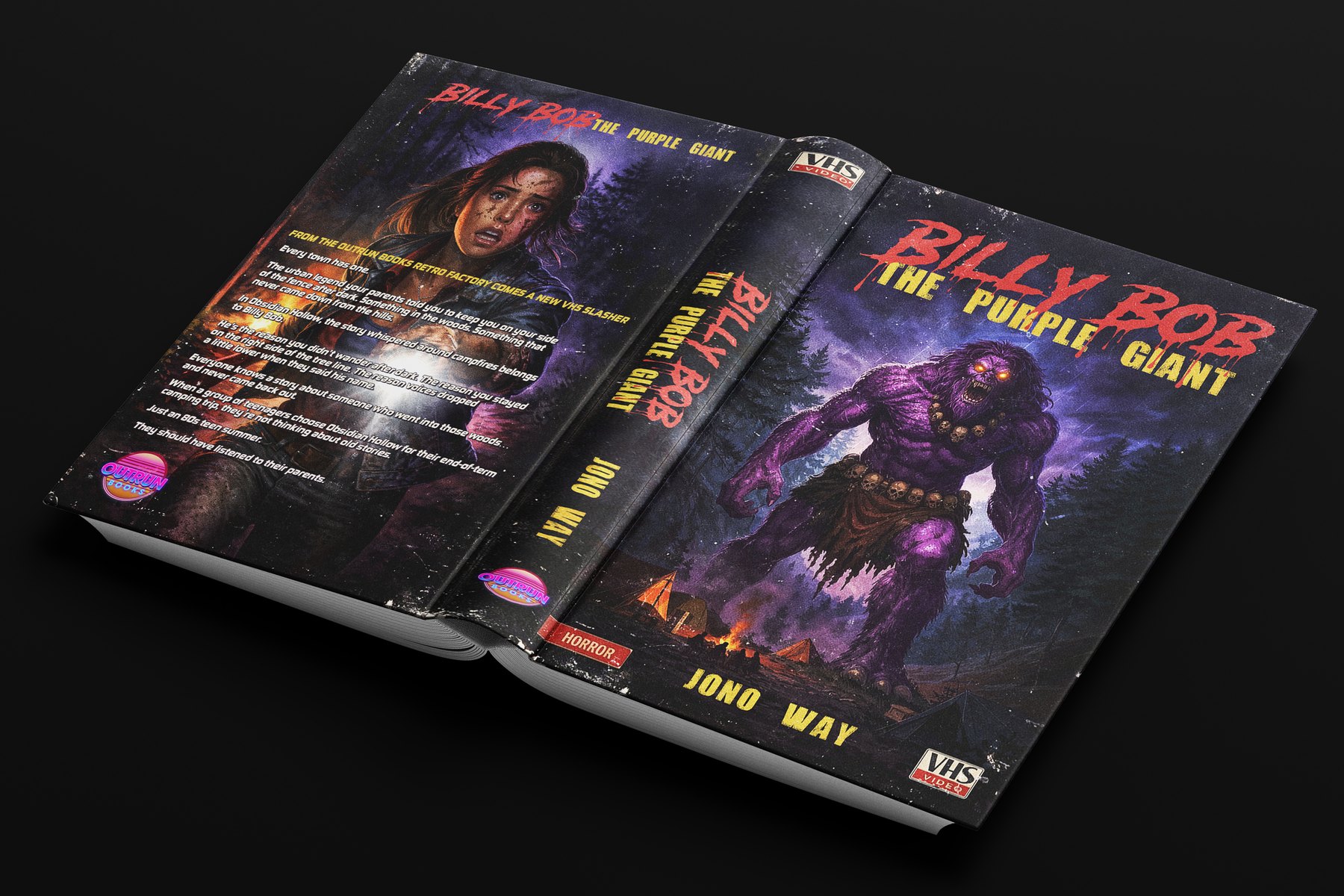
That’s the story nobody in the family talks about—and it’s not even the scary part. Billy Bob: The Purple Giant is out now in paperback and on Kindle, worldwide.